A mind stretching podcast on intelligence and how it is perceived.

Krista Tippett from On Being interviews Mike Rose on intelligence across all professions and how the measures and cultural perceptions we currently have on intelligence might be too narrow.

MIKE ROSE is a research professor in the UCLA Graduate School of Education and Information Studies. He’s the author of several books, including The Mind at Work: Valuing the Intelligence of the American Worker, Why School?: Reclaiming Education for All of Us, and more recentlyBack to School: Why Everyone Deserves a Second Chance at Education.

Podcast

Mind set

Part of the job of being a School Psychologist and Educator is helping folks develop a positive working relationship. Part of that working relationship requires developing clear communication and boundaries that lead toward positive outcomes. The video below helps to adopt a positive mind set.

Study tool called Quizlet

Quizlet is an online learning tool created by high school sophomore Andrew Sutherland in Albany, California. It was originally conceived in October 2005 and released to the public in January 2007.[2] As of January 2014, Quizlet has over 60 million user-generated flashcard sets and more than 20 million registered users.[3][4]

One of the Special Day Class teachers is using Quizlet to help support vocabulary from a book that they are reading. It is easy to set up. The kids are really engaged in the subject material.

There are a lot of different ways to use this application. You can also set up a matching game to match a word with it’s definition and create tests.

There are also hundreds of pre-made study areas to choose to learn from. I liked the Praxis II exam for School Psychologists.

Super Duper Handouts 

Super Duper® Handy Handouts® a are FREE online, informational newsletters for teachers and parents. I love these handouts for a variety of reasons. Mostly because they are short, accurate, and cover a multitude of topics. I typically will use them to help build better understanding of what a student might need to parents and teachers.

Handouts
They also have these other resources that are special education and Speech Therapist centric resources.

Age Calculator

Apps

CEUs

Handy Handouts

Response Analyzer

SLP Case History Form

Link: Other free resources 

Super Duper also sells really good materials to support teaching discrete skills sets primarily around Speech and Language impairments. I find the pragmatic (social skills) materials to be especially helpful in working with students individually and in groups.

Super Duper site

Parent Volunteer Infographic

Image

Parent volunteers are a vital resource for schools

Being a school psychologist, I have the benefit of visiting a wide variety of schools in a given year. I have observed that campuses that have well developed parent and community volunteers often function at a higher level than those who don’t have the luxury of volunteers.

Article

Opening the Classroom Door: Inviting Parents and Preparing to Work Together in Classrooms

UCLA Looks at Parent Volunteers

Volunteers can have a very powerful impact on the students and schools. What follows briefly highlights some research on the benefits and ways to use volunteers and ways for schools to move forward in implementing volunteer programs.

What Research Says

Henderson and Mapp (2002) report evidence that volunteers can be significant resources in helping create a supportive and welcoming environment at schools and facilitating students’ behavior and performance. As positive role models and student motivators, volunteers are viewed as contributing to better school attendance, improved grades and test scores, matriculation, less misbehavior, better social skills, staying in school, graduating, and going on to college.

The Many Roles for Volunteers in the Classroom and Throughout the School I. Welcoming and Social Support

A. In the Front Office

1. Greeting and welcoming

2. Providing information to those who come to the front desk

3. Escorting guests, new students/families to destinations on the campus

4. Orienting newcomers

B. Staffing a Welcoming Club

1. Connecting newly arrived parents with peer buddies

2. Helping develop orientation and other information resources for newcomers

3. Helping establish newcomer support groups

II. Working with Designated Students in the Classroom

A. Helping to orient new students

B. Engaging disinterested, distracted, and distracting students

C. Providing personal guidance and support for specific students in class to help them stay focused and engaged

III. Providing Additional Opportunities and Support in Class and on the Campus as a Whole – including helping develop and staff additional

A. Recreational activity

B. Enrichment activity

C. Tutoring

D. Mentoring

IV. Helping Enhance the Positive Climate Throughout the School – including Assisting with “Chores”

A. Assisting with Supervision in Class and Throughout the Campus

B. Contributing to Campus “Beautification”

C. Helping to Get Materials Ready

Source: http://smhp.psych.ucla.edu/pdfdocs/vols.pdf

Class Dojo

We recently piloted a behavior management system in one of our Special Education Classroom called Class Dojo. Each child is assigned a little fuzzy avatar and the teacher can give positive and negative points based on how the student behaves in class. The teacher can email a link to each kids parent so they can see how their day was at school. It has proven to be a powerful tool and a great way to keep parents in the loop with behavior in the classroom.
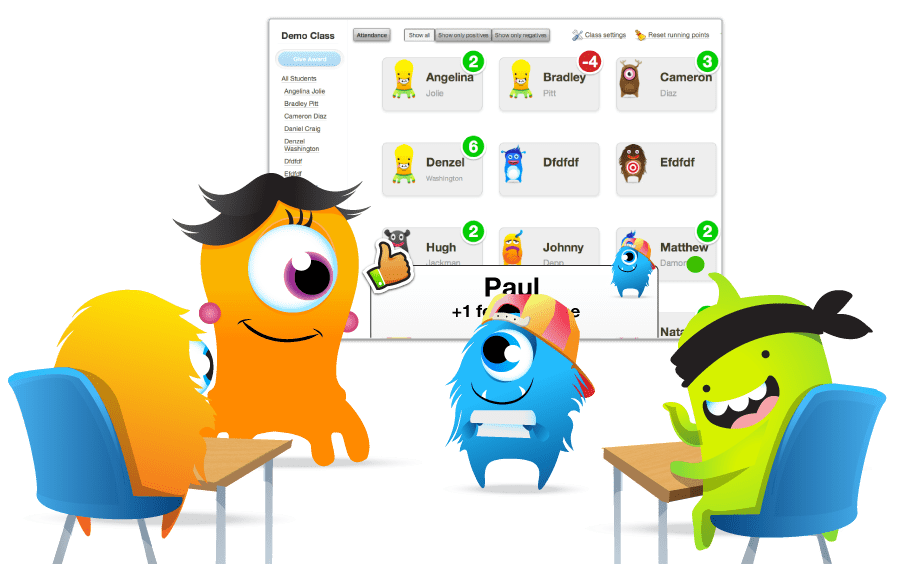
Here is the feel good commercial: Warm Fuzzies

Here is a nuts and bolts of how to get started: Start up Tutorial

Apple App store Link: Apple Link

Google Play Store: Android

Expected verses Unexpected Behaviors

Perspective taking is really important for our kiddos building capacity in the area of social skills. Categorizing Expected verses Unexpected can be crucial to developing a filter when making a good choice verses and not so good choices.

DEFINITION OF EXPECTED VS UNEXPECTED (Kid friendly)

MAPPING EXPECTED AND UNEXPECTED
Expected -Simple Map
Unexpected – Simple Map
Expected vs Unexpected – Sophisticated

ACTIVITY
Expected vs Unexpected Activity

POWERPOINT ACTIVITY

PPT

GENERAL PERSPECTIVE TAKING RESOURCES
1st Link

2nd Link

3rd Link

PENT and Diana Browning Wright

Recently, Diana Browning Wright came to present to our Special Education staff on a variety of subjects, but primarily on empirically based proven behavioral practices. She is a dynamic and knowledgable educator that has definitely forgotten more about child behavior than I will ever know.

Her website PENT website is a great. I particularly like Positive Environments and RtI it reviews how to set the student up for success in a variety of environments. I use these strategies with the students and teachers I work with at school.

Special Educators using Google Docs, Forms, and Spreadsheet

Special Educators using Google Docs, Forms, and Spreadsheets

Articles

http://ny.chalkbeat.org/2014/03/25/how-my-school-is-bringing-teachers-together-to-improve-students-ieps/#.Vc455JNVikr

http://www.teachingspecialthinkers.com/2013/05/be-proactive-using-google-docs-to.html

http://www.teachingspecialthinkers.com/2013/05/be-proactive-10-ways-to-use-google-docs.html

FORMS

Learning Skills Self-Assessment

This is a great tool to interview a student to get their perspective on their own learning. It covers the soft skills that make learning more efficient and productive. An added benefit is that it is a chance to find neutral and common ground between the student and teacher.

https://docs.google.com/forms/d/1OBlaJoZYoBDPT_NPbttTp8B4XKqnlyxAuCG5kacZg1M/viewform

Learning Profile Questionnaire

https://docs.google.com/forms/d/1qhxPkzgQisyW79Hr9WxwRPNFViccoPf1eBjj1U9dl38/viewform

Observed Behaviors

https://docs.google.com/forms/d/1CewcuVvuDQktf5MN_9P2UajIGkcPqr7h6veNjSwASIE/viewform
