Transgender and Gender Diverse Students

While this is a hot topic politically. In public schools we have been working with diverse populations for awhile. Here is some information to better support Transgender and Gender Diverse students.

Start here:


Some statistics

How many people are lesbian, gay, bisexual, and transgender?

Increasing numbers of population-based surveys in the United States and across the world include questions that allow for an estimate of the size of the lesbian, gay, bisexual, and transgender (LGBT) population. This research brief discusses challenges associated with collecting better information about the LGBT community and reviews eleven recent US and international surveys that ask sexual orientation or gender identity questions. The brief concludes with estimates of the size of the LGBT population in the United States.

Key findings from the research brief are as follows:

  •  An estimated 3.5% of adults in the United States identify as lesbian, gay, or bisexual and an estimated 0.3% of adults are transgender.
  •  This implies that there are approximately 9 million LGBT Americans, a figure roughly equivalent to the population of New Jersey.
  •  Among adults who identify as LGB, bisexuals comprise a slight majority (1.8% compared to 1.7% who identify as lesbian or gay).
  •  Women are substantially more likely than men to identify as bisexual. Bisexuals comprise more than half of the lesbian and bisexual population among women in eight of the nine surveys considered in the brief. Conversely, gay men comprise substantially more than half of gay and bisexual men in seven of the nine surveys.
  •  Estimates of those who report any lifetime same-sex sexual behavior and any same-sex sexual attraction are substantially higher than estimates of those who identify as LGB. An estimated 19 million Americans (8.2%) report that they have engaged in same-sex sexual behavior and nearly 25.6 million Americans (11%) acknowledge at least some same-sex sexual attraction.
  •  Understanding the size of the LGBT population is a critical first step to informing a host of public policy and research topics. The surveys highlighted in this report demonstrate the viability of sexual orientation and gender identity questions on large national population-based surveys. Adding these questions to more national, state, and local data sources is critical to developing research that enables a better understanding of the understudied LGBT community.Source

How to Talk to Kids About What it Means to be Transgender

genderbread-person-3-3


Other readings:

GLAAD Media Reference Guide

us-dept-of-justice-letter

transwk1

transgender-youth-2013

trans children

Policies on Transgender Students for across the United States

 Atherton High School, Jefferson County School District (KY), Policy on School Space (2014), 

 Boulder Valley School District (CO), Guidelines Regarding the Support of Students and Staff Who Are Transgender and/or Gender Nonconforming (2016), 

 California Interscholastic Federation, Guidelines for Gender Identity Participation (2015), 

 Chicago Public Schools (IL), Guidelines Regarding the Support of Transgender and Gender Nonconforming Students (2016), 

 Massachusetts Department of Elementary and Secondary Education, Guidance for Massachusetts Public Schools Creating a Safe and Supportive School Environment Nondiscrimination on the Basis of Gender Identity (2014), 

 Matanuska-Susitna Borough School District (AK), Transgender Student Guidelines (2015), 

 New York State Education Department, Guidance to School Districts for Creating a Safe and Supportive School Environment for Transgender and Gender Nonconforming Students (2015), 

 Rhode Island Interscholastic League, Rules & Regulations (Article I, Section 22 – Gender Identity), 

 Shorewood School District (WI), Nondiscrimination Guidelines Related to Students Who Are Transgender and Students Nonconforming to Gender Role Stereotypes (2014), 

 Washington Office of State Superintendent of Public Instruction, Prohibiting Discrimination in Washington Public Schools (2012),

LGBT Resource List


Behavioral practice

141952495-school-kids

Every kid has a point in time when they need either their parents and/ or teachers to support them with learning new behavioral skills.

Practical Practice Ideas for developing a variety of social emotional skills.

Taking Turns and Being Patient

Please take a moment and practice these skills at school and at home by:

  • Playing a Game
  • Reminding me to wait my turn
  • Asking me what
  •  I can do while I wait for my turn


Having rules and Following rules

Please take a moment and practice these skills at school and at home by:

  • Asking your student why rules are important
  • By playing a game with rules
  • By creating new rules


Feelings and Emotions

Please take a moment and practice these skills at school and at home by:

  • Asking your student to name as many feelings as they can
  • Encourage your student to verbally name their feelings
  • Verbally expressing your feelings as the parent/teacher
  • Asking your student to identify the feelings of others in a story or on television
  • Have your student show you what different emotions look like


Using “I” statements

Please take a moment and practice this skill at school and at home by:

  • Having you student use “I” statements throughout the week (e.g. “I feel…”, “I want…”, “I think…”)
  • Ask student why it is important to use “I” statements
  • Ask student in what setting they should use “I” statements


Anger

Please take a moment and practice recognizing Anger at school and at home by:

  • Asking what your students body look like when they are Angry.
  • Ask your student to explain the Grouchometer
  • Ask your student where they are on the Grouchometer throughout the week


Words and there meanings

Please take a moment and practice these skills at school and at home by:

  • Asking your student what kind of messages words send.
  • Ask your student to give examples of “Nice” words
  • Ask student why people may say “Not Nice” words


Anger

  • Asking what your students what they should do when angry
  • Ask your student to explain things that may be triggers for Anger
  • Ask your student what they can say if they are Angry
  • Practice “Stop and Think” to calm down


Teasing

  • Ask your student, “What does teasing look like?”
  • Ask your student what are their options for dealing with teasing (ignore, agree, tell adult, ask, “Why did you say that?” Say, “I want you to stop”).
  • Role-play situations and ask your student what they would say or do in these situations.


Consequences

  • Recognizing that there may be both positive and negative consequences.
  • Have your student list positive and negative consequences throughout the week.
  • Role-play scenarios and have your student state appropriate consequences.
  • Play a board game that has consequences


Problem-Solving

  • Role-play disagreements and ask “what does each person need?”
  • Have students consider consequences
  • Have your student make the best choice or make a plan to help with problem solving.
  • Reflect on whether or not the plan worked

Other Resources:

Vanderbilt CSEFEL- Practical Strategies for Teachers/Caregivers

“You Got It!” Teaching Social and Emotional Skills

Fostering Social and Emotional Skills Development in Early Childhood – PPT

Resilience Booster: Parent Tip Tool – APA resource


Selective Mutism

100_5015

What is Selective Mutism

Selective Mutism is a complex childhood anxiety disorder characterized by a child’s inability to speak and communicate effectively in select social settings, such as school. These children are able to speak and communicate in settings where they are comfortable, secure, and relaxed.


For Teachers

Understanding Selective Mutism A Guide to Helping Our Teachers Understand

SELECTIVE MUTISM: RECOMMENDATIONS FOR TEACHERS

Tips for Helping Kids With Selective Mutism Go Back to School

For School Psychologists

Selective Mutism DSM-5 312.23 (F94.0)

Silent Suffering: Children with Selective Mutism

Tool Kit- Supporting Children with Selective Mutism Practice Guidelines

CASP Article-Selective Mutism: A Three-Tiered Approach to Prevention and Intervention

PREZI- Selective Mutism

School Evaluation Form

For Speech Pathologists

Selective Mutism – Speech-LanguagePathologist

A Socio-Communication Intervention Model for Selective Mutism

Speech-Language Therapy and Selective Mutism

Selective Mutism: Assessment and Intervention

Good PPT

School Speech Questionnaire and other supportive tools

Great Blog Post on Treatment of Selective Mutism with Tools!!!

Resources for Selective Mutism:

source

Book- The Silence Within: A Teacher/Parent Guide to Working with Selectively Mute and Shy Children. by, Gail Goetze Karvatt

http://www.amazon.com/dp/0615121519?tag=pediastaff0d-20&camp=213381&creative=390973&linkCode=as4&creativeASIN=0615121519&adid=0V5WF1JFZHYN95DPRADE

Wikipedia – Selective Mutism http://en.wikipedia.org/wiki/Selective_mutism

The organizations which have information on selective mutism:

K12 Academics

NYU Child Study Center

Selective Mutism Foundation

Selective Mutism and Childhood AnxietyDisorders Group

Child Mind Institute

http://www.childmind.org/en/clinics/programs/selective-mutism-program

http://www.childmind.org/en/nightline-selective-mutism/ 

Selective Mutism on Line http://selectivemutismonline.com


Tools and Screenings

recruiting_tools-_10_candidate_sourcing_tools_you_may_not_be_using

I recently found a site through res_uwmedicalcenter books in the Treatments That Work™ series that currently have resources available for download. I have used a few and wanted to take a chance and post it to the blog for future reference.

First Treatments That Work- Here

and

res_uwmedicalcenter

On these topics:

SCREENING & SURVEILLANCE –(SOURCE)

Home School Communication

Parents teacher meeting

Home school communication a great tool in working with challenging behavior. Parents often hold the keys to change.

Here are some examples:

Look at examples on pages 35-37

Principles and examples of home school communication from PENT: here

More examples of blank templates: here and here

Articles:

11 Rules for Better Parent-Teacher Teamwork

Sharing Data to Create Stronger Parent Partnerships

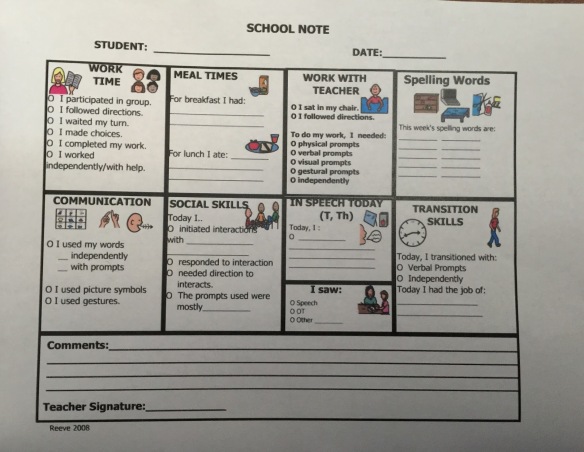
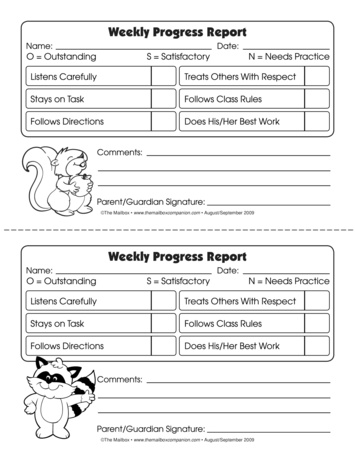
Visually readable progress reports

Simple:

96072_0_lg

Source

To more involved:

school2bnote

Daily Behavior Report Cards (DBRC)

Ongoing communication between home and school is an important component to behavior plans. DBRCs can be a very easy, efficient and helpful way of motivating students as well as informally monitoring behavioral improvement with intervention. Teacher behavior report cards can be designed to accomplish the following:

  •  Point out to the students behaviors that they need to learn (skill deficit).
  •  Provide a schedule of teacher attention/feedback for positive behaviors.
  •  Motivate students through reinforcing positive behavior that teachers want to increase, and providing consequences (e.g., a sad face) for negative behaviors they want to decrease.
  •  Increase home-school communication (increase accountability with additional opportunities for positive or negative consequences for behavior).
  •  Evaluate whether the intervention is working or not when used with other measures.

Source

Top Five Reasons to Engage Parents

1. Decades of research show when parents are involved students have:

  • – Higher grades, test scores, and graduation rates
  • – Better school attendance – Increased motivation, better self-esteem
  • – Lower rates of suspension
  • – Decreased use of drugs and alcohol
  • – Fewer instances of violent behavior

National Parent Teacher Association

2. Family participation in education is twice as predictive of students’ academic success as family socioeconomic status. Some of the more intensive programs had effects that were 10 times greater than other factors. Walberg (1984) in his review of 29 studies of school–parent programs.

3. School Benefits:

  • – Improves teacher morale
  • – Higher ratings of teachers by parents
  • – More support from families
  • – Higher student achievement
  • – Better reputations in the community

A New Generation of Evidence: The Family is Critical to Student Achievement, edited by Anne T. Henderson and Nancy Berla, Center for Law and Education, Washington, D.C., 1994 (third printing, 1996)

4. Parent involvement leads to feelings of ownership, resulting in increased support of schools. Davies, Don. (1988). Low Income Parents and the Schools: A Research Report and a Plan for Action. Equity and Choice 4,3 (Spring): 51-57. EJ 374 512.

5. Parents express a genuine and deep-seated desire to help their children succeed academically, regardless of differences in socioeconomic status, race, ethnicity, and cultural background. Mapp (1999)

Source


I am giving a brief talk tonight!

pvusd-logo-green

COMMUNITY ADVISORY COMMITTEE &
SPECIAL PARENTS INFORMATION NETWORK(CAC & SPIN)

JOIN US AND SHARE YOUR IDEAS!

TUESDAY, MARCH 8, 2016 FROM 6:30PM TO 8:00PM

PVUSD DISTRICT- BOARD ROOM
294 GREEN VALLEY ROAD, WATSONVILLE
REFRESHMENTS WILL BE PROVIDED

Meeting Topics

 Addressing Social and Learning Needs Through Utilizing Web-Based
Resources, Presented by Corey Tamblyn
Blog: https://buildingmomentuminschools.wordpress.com
 The Importance of Movement- Adaptive Movement from the
Adaptive Yoga Project, Presented by Annica Rose

The CAC is composed of parents of individuals with disabilities enrolled in public or
private schools, parents of nondisabled students, students and adults with
disabilities, general education teachers, special education teachers and other school
personnel, representatives of other public and private agencies, and persons
concerned with the needs of individuals with disabilities.

Letter of Introduction

openletter

From year to year our students change teachers and the transition can be difficult for all parties. Learning about what works at school for that particular student is especially important if they require different support at school. I recently can across an example of a letter of introduction that was written by a mom who really knew how to articulate “what works” for her child. Here is a link to her letter and some other examples to help with introducing your kids particular needs to a new teacher.

A Letter to My Child’s Teacher

A student letter from an older student might read:


This article is property of and copyright © 2003-2007 Jene Aviram of Natural Learning Concepts. Reference of this article may only be included in your documentation provided that reference is made to the owner – Jene Aviram and a reference to this site http://www.nlconcepts.com

FIFTEEN THINGS ABOUT ME

Hi, my name is XXX and I am in your class this year. I want you to know a little about me.

I’m nervous to be in your class because it’s new and I don’t know what to expect. I need some time to adjust and then I will feel comfortable. Please don’t judge me on my first few weeks.

As the time goes by, you will be amazed by the skills you never thought I possessed. I sometimes look like I don’t understand. That’s just because I don’t have the same expressions and reactions as other people. I might not look at you when you talk but that doesn’t mean I didn’t hear you. I did. In fact I usually hear more than most people.

As I become familiar with your classroom I will begin to shine. A great way to speed up this process is letting me know what to expect.

Written or picture schedules for the day reduce my anxiety.

A five minute warning before a change of activity can help me greatly too.

You are my teacher and I look up to you. I want to succeed this year but I can’t do it without your help and most importantly, your belief in me that I can do it!

  1. What is my general disposition?


  1. What am I really, really good at?


  1. What do I absolutely LOVE doing?


  1. What do I absolutely HATE doing?


  1. What academics are my strong areas?


  1. What academics do I need a lot of extra help with?


  1. Which skills would my parents really like me to work on this year?


  1. How do you know when I’m getting frustrated?


  1. What can you do to calm me down before the storm hits?


  1. Too late! The storm hit! What can you do to calm me down?


  1. What strategies work really well to get me to do something I don’t want to do?


  1. What typically makes me laugh?


  1. What consequences back-fire and don’t give the desired results?


  1. I don’t like consequences, but which consequences work well for me?


  1. I would also like you to know…

Source

Or

For younger children- The ABC’s Of My Child

Here are some materials to help identify your child’s strengths.

Checklist: Know Your Child’s Strengths

Child Strengths Checklist

Capture Your Child’s Super Strengths

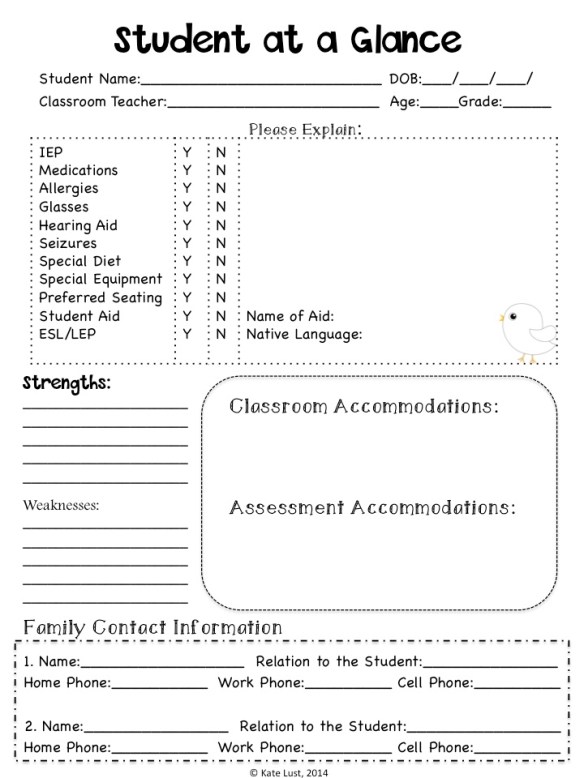
Below is an example of how to simply display your students needs at school.

slide2


Vote for the content on this blog that you need to support your Student(s).

Classroom Behavior – Big Ideas

smiling_class

Classroom Behavior is a big topic, but I think that it is one that needs to be reflected upon even if your classroom is running well.

Big reads

Classroom Management & Culture

Case Studies in Educational Psychology  by John W. Santrock

Starting Small Teaching Tolerance in Preschool and the Early Grades

Great PowerPoints

Teaching Expectations and Reinforcement Systems


Establishing and implementing classroom rules

Jones and Jones stated that effective, general rules in a classroom should pertain to (a) health and safety (e.g., “Walk in the classroom, hallways, cafeteria.”), (b) property loss and damage (e.g., “Respect others’ personal property and touch it only with the person’s permission.”), (c) legitimate educational purpose (e.g., “Be on time for class and with all assignments.”), and (d) disruption of the learning process (e.g., “Ask for permission to speak before saying anything in the classroom.”).4 The following are characteristics of good classroom rules regardless of teaching level:

The fewer, the better.
It is wise to keep the number of rules to a minimum. For primary-level students, three or four rules should suffice; for older adolescents, as many as five or six may be necessary. There are ways to cover many activities in a rule by composing it in a broad fashion. Instead of limiting the rule to only the classroom (e.g., “Walk at all times in the classroom.”), a broader rule could state, “Always walk in the classroom, hallways, and cafeteria.”).
Use simple language.
There is no need to write elaborate rules with complex language. Just be direct and simple (e.g., “Raise your hand and wait for the teacher to call on you before speaking.”). If anything, direct, simple language allows for students to remember the rules more easily.
Use a positive voice.
If at all possible, write the rules in a positive format and tone. Try to avoid, “You shall not talk in the classroom without teacher permission,” by stating the same rule as, “Ask for permission to speak before saying anything in the classroom.”
Special context, special rules.
Different rules can be used for special situations and learning stations in the same classroom environment. Rules for using computers in a classroom (e.g., “Always use headphones when listening to music on the computer.”) can be made very specific to that activity and station only.
Create an effective display.
Rules need to be prominently displayed in the classroom or in a special activity area. When students are first learning the rules in the beginning of the school term they need to be bombarded and reminded of them as much as possible. Put them on a bulletin board, duplicate them on the classroom whiteboard, write them on a handout to distribute to class members, and place them in special activity areas (e.g., computer stations). I once witnessed a teacher hanging each classroom rule from the ceiling on both sides of long poster board for all to see in any section of the room. (Now that’s displaying them prominently!)


Taking Care of the Caretaker

you-are-important

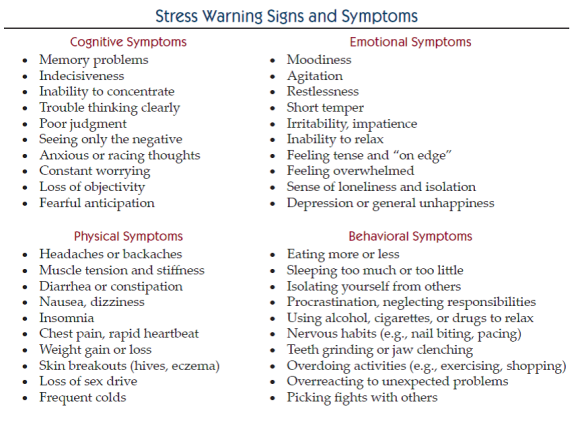
A few months ago I wrote a post called, “Check your Stress!” While it had some good tools to identify whether or not you were stressed, getting to the mindset of self care is something I have observed many parents and teachers avoid even if they realize it is affecting their work and happiness. Here are a few resources out there.

Get informed

Seven Types of Self-Care Activities for Coping with Stress

Self Care Advice for Caring Professionals

The Internet Wants to Help You Take Care of Yourself Stop. Are you hungry? Then eat something before reading this.

Self-Care For Teachers by Anne Brunette, MSW, Family Therapist

How Self-Compassion Can Help Prevent Teacher Burnout

Stess Warning Signs and Symptoms

Write about it

Simple approach
Think about ways of behaving, feeling or thinking that you would like to: • stop • start • continue.
For example: I would like to stop feeling guilty that I am not doing more for my ill family member. I would like to start taking an afternoon time out just for myself, to go shopping or to do yoga or to visit with friends. I would like to continue going to a family self-help group such as the Mood Disorders Association of Ontario when this support group ends.
_________________________________________________________
Write down your wishes.
Stop: ____________________________________________________________
Start: ____________________________________________________________
Continue: ____________________________________________________________

Activity : Quick wins

Get Help

Get a Therapist.  In the US or Canada this link will find a therapist for you.

Some measures of Stress and Burn out

PROFESSIONAL QUALITY OF LIFE SCALE (PROQOL)

ARE YOU BURNING OUT?

Putting Things Into Perspective Where is your time going?

Tself-care assessment scale by Saakvitne and Pearlman from the Traumatic Stress Institute.

Ted Talk Videos

Self Care

Other Links

Self-Care for Teachers

The following resources can help you cope with some of the common sources of stress and burnout among educators and others in the helping professions.

Self-Care Review – Checklist

Student SELF-CARE Manual (Good tools)

Self-Care Domains In each domain, list the activities you are doing to take care of yourself.

My Self Care Plan

Workbook with Self Care tools

Self Care Strategies

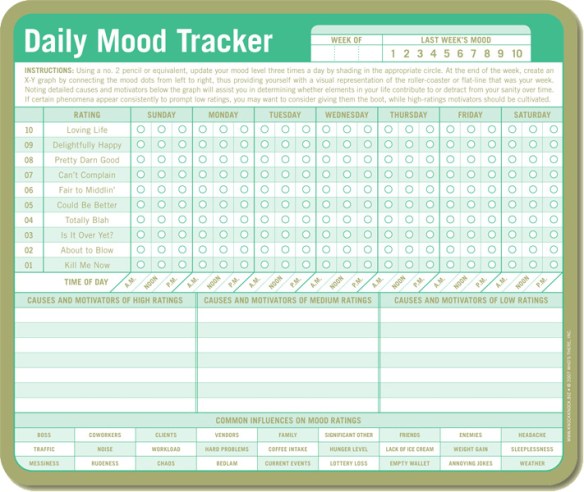
daily-mood-tracker-knock