Great Curriculum Resource

foresight_logo

http://www.foresightreport.org/

The ForeSight Report is a curriculum treasure trove.

It covers grades K-8 and you can sort the materials of Math, ELA/ Writing, and Science within the areas listed below.

Areas:

  • Strategy
  • Engagement
  • Standards
  • Resources
  • Lesson Plan
  • Video
  • Classroom Mgnt*
  • Leadership*
  • Pedagogy*
  • Other


  17,972 Sources – Researched by Master Educators
♦  New Ideas & Best Practices From Educators Nationwide
  Guaranteed Actual Classroom Strategies & Insights
♦  Save Time and Collaboratively Develop Staff


The Magic Ratio 5 to 1

a8d994ab65ee962a078770ab8e41e0cf

According to relationship researcher John Gottman, the magic ratio is 5 to 1. What does this mean? This means that for every one negative feeling or interaction between partners, there must be five positive feelings or interactions. Stable and happy couples share more positive feelings and actions than negative ones.

Students need to feel valued and safe to take risks with their learning.

Video


PowerPoint

Classroom Management & the Power of Positive Reinforcement: A How To Guide

Reading

Praise’s magic reinforcement ratio: five to one gets the job done.

100+ Ways To Praise A Child

I like the imagery of the burger below, however I prefer “corrective feedback” over “criticism”.

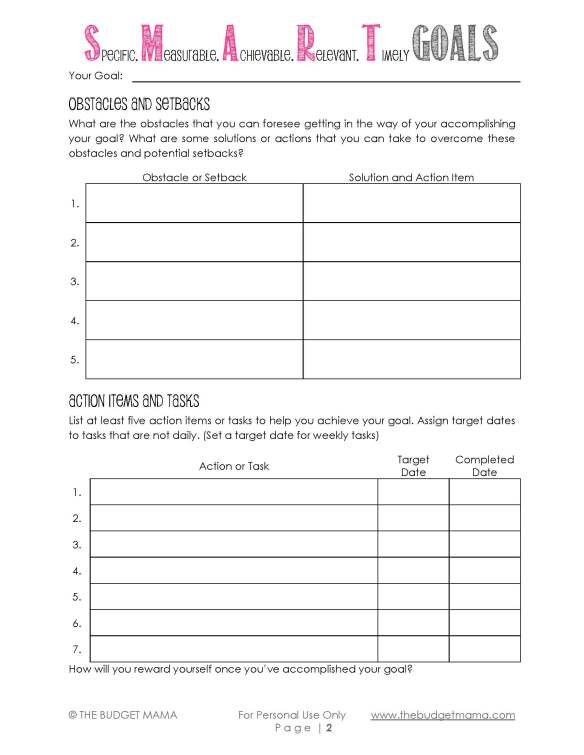
SMART Goal Setting with Students

smartgoals

STRATEGIES

smart-goal-setting


Edutopia article Link Source

READING

Setting Goals: Who, Why, How?

SMART Goals Connect a School – Jan O’Neill

Student Achievement Goal Setting Guidebook (DOC)

VIDEO

ACTIVITIES

Personal Values – Activity

goal-setting-workbook_page_2

goal-planning-sheet

Unless you try to do something beyond what you have already mastered, you will never grow.

Ralph Waldo Emerson


Differentiating Instruction

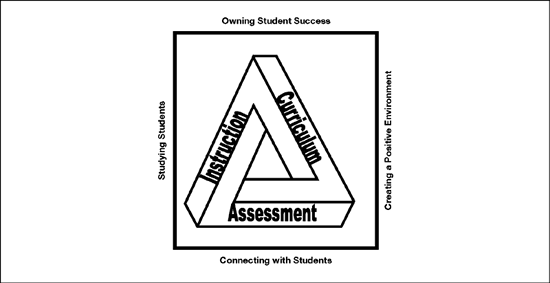
tomlinson2010_fig1-2

The graphic above demonstrates the “Interdependence of Key Classroom Elements” when executing Differentiated Instruction.

Whether you need motivation to implement differentiated instruction in the classroom or simply need reassurance that it’s working, you’ll find inspiration in these words of wisdom from Tomlinson:

  1. Every child is entitled to the promise of a teacher’s optimism, enthusiasm, time, and energy.
  2. Educators should be champions of every student who enters the schoolhouse doors.
  3. Teachers in the most exciting and effective differentiated classrooms don’t have all the answers. What they do have is optimism and determination.
  4. It is a human birthright to be a learner. There is little we do that is more important.
  5. Like students, teachers grow best when they are moderately challenged. Waiting until conditions are ideal or until you are sure of yourself yields lethargy, not growth.
  6. Teachers change either because they see the light or because they feel the heat.
  7. A great coach never achieves greatness for himself or his team by working to make all his players alike.
  8. Becoming an expert at differentiation is a career-long goal. One step at a time, you will get there.
  9. Don’t feel compelled to grade everything. There’s a time for students to figure things out and a time for judging whether they did, but the two shouldn’t always be the same.
  10. If curriculum and instruction are the heart and limbs of sound teaching, then classroom management is the central nervous system. Without the heart, there is no life, but without the nervous system, there is no function. Source

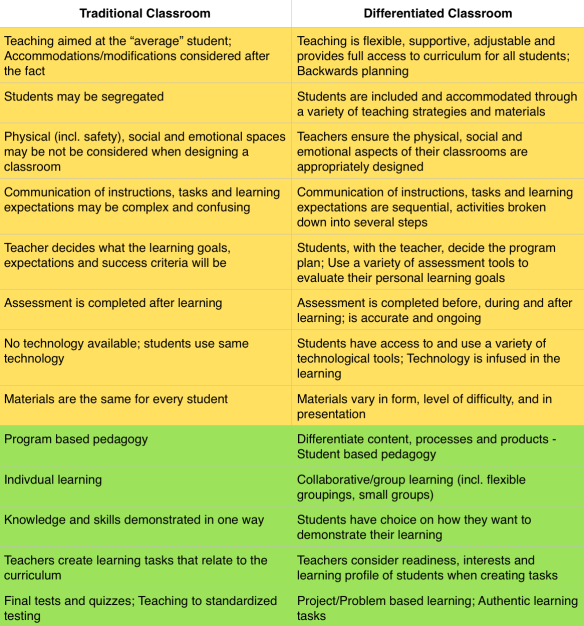
The below graph helps to further describe what the  specific aim of Differentiated Instruction.

screen_shot_2015-07-31_at_5-59-00_pm


READING

How to Differentiate Instruction in Mixed-Ability Classrooms, 2nd Edition by Carol Ann Tomlinson

Differentiating Instruction: Making It Happen in Classrooms By Dr. Vicki Gibson

Differentiated Instruction: A Primer

Differentiated Instruction for Students with Learning Disabilities

Great PowerPoint on Using Assessment to Drive Instruction

Using Assessment to Drive Instruction PDF of a PPT

Assessments to help with the process of Differentiating Instruction

Differentiated Instruction Self-Assessment

LINK- The Bender Classroom Structure Questionnaire (a self-evaluation of your classroom)

Scoring the BCSQ

Scoring the BCSQ may be done either formally or informally. Because these techniques generally represent “best practices,” a higher score on the BCSQ is more desirable and indicates that a teacher is employing the instructional techniques that should facilitate successful inclusion. To get a general score, one may merely total the circled score for each indicator, resulting in a score that ranges from 40 (the lowest possible score) to 200. Bender (1992) reported that a group of 127 general education teachers in Georgia (from Grades 1 through 8) generated a total score of 143 (SD = 19) on this questionnaire. A group of 50 teachers from New Jersey (Grades 3 through 12) generated a score of 139 (SD = 19) on this scale. These general scores may provide some indication of how you provide varied instruction for students with learning disabilities in your class.

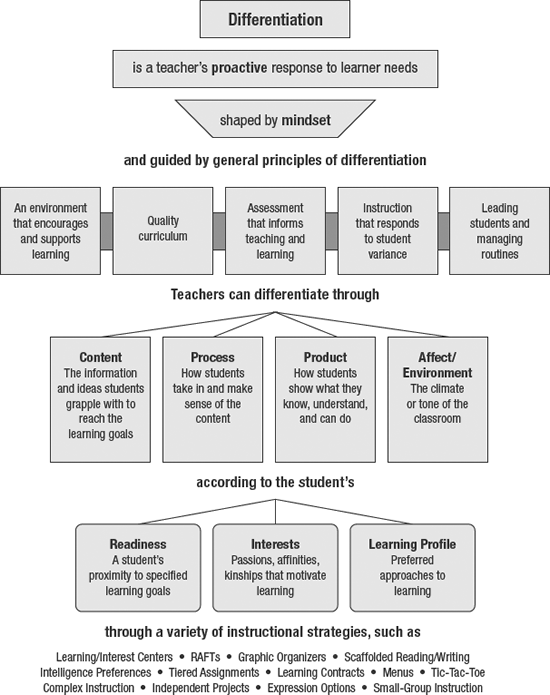
tomlinson2013_fig1-1


The Abecedarian Reading Assessment


1382370627415

In working through the pre-referral process with teachers to help identify reading issues, we ran across the Abecedarian Reading Assessment. It is free and easy to use and have found that the information it provides helps to guide the interventions we use in the Student Study Team process.

The Abecedarian Reading Assessment was designed to test what research has shown to be the most essential knowledge domains for developing reading skills.  The knowledge domains assessed by the Abecedarian include:


• Letter Knowledge
• Phonological Awareness (Rhyme and Phoneme Identity)
• Phoneme Awareness (First and Last Sounds and Phoneme Segmentation)
• Knowledge of the Alphabetic Principle
• Vocabulary (Production, Synonyms, and Antonyms)
• Decoding (Fluency, Regular Words and Irregular Words)


Written by two reading researchers, Sebastian Wren and Jennifer Watts, the Abecedarian is available for you to download and use for free.  It is a large document (over 50 pages long), so it may take a while to download if you have a telephone connection.  The authors have given permission for this document to be reproduced freely on two conditions:

• The Abecedarian may not be altered.
• Appropriate credit must be given for authorship.

San Diego Quick Reading Assessment

sunset-water-reflection-with-pier1

San Diego Quick Assessment List

The San Diego Quick Assessment List is a very useful, quick way to determine a child’s approximate instructional reading level. It is certainly not a substitute for giving an Individual Reading Inventory with its graded word lists and graded reading passages. However, if a reading teacher merely wants a very easy, quick estimation of a child’s approximate instructional reading level, we have found it to be fairly useful for that purpose. NOTE: The San Diego Quick Assessment List never should be thought of as a substitute for an Individual Reading Inventory, but it can be useful for the purpose for which it was designed.

Administration

1. Type out each list of words on index cards.

2. Begin with a card that is at least two years below the child’s grade-level assignment.

3. Ask the child to read the words aloud to you. If he or she misreads any on the list, drop to easier lists until he or she makes no errors. This indicates the base level.

4. Write down all incorrect responses, or use diacritical marks on your copy of the list. For example, acrid might be read and recorded as acid. Molecule might be recorded a mole (long o) cule.

5. Encourage the child to read words that he or she does not know so that you can identify the techniques he or she uses for word identification. 6. Have the child read from increasingly difficult lists until he or she misses at least three words.

Analysis

1. The list in which the child misses no more than one of the ten words is the level at which he or she can read independently. Two errors indicate the instructional reading level. Three or more errors indicate material that may be too difficult (frustration reading level).

2. An analysis of the child’s errors is useful. Among those that occur with the greatest frequency are the following: Error Example reversal how for who consonant book for look consonant blend string for spring short vowel note for not long vowel rod for road prefix protest for pretext suffix entering for entered miscellaneous (omission of accent, etc.)

3. As with other reading assessment devices, teacher observation of student behavior is very important. Such things as posture, facial expression, and voice quality may signal nervousness, lack of confidence, or frustration while reading

San Diego Quick Reading Assessment (PDF)

San Diego Quick Reading Assessment (PDF) #2

San Diego Quick Reading Assessment (DOC)

Grade Retention

03kind600-400x176

Grade retention or grade repetition is the process of having a student repeat an educational course, usually one previously failed. Students who repeat a course are referred as “repeaters”. Repeaters can be referred to as having been “held back”. Source

A Handout for Educational Professionals.

A common misperception is that giving a student the “gift” of another year in the same grade will allow the child time to mature (academically and socially); however, grade retention has been associated with numerous deleterious outcomes. Without specific targeted interventions, most retained students do not “catch up.”

Research Regarding Retention:

Temporary gains. Research indicates that academic improvements may be observed during the year the student is retained, however, achievement gains typically decline within 2–3 years of retention.

Negative impact on achievement and adjustment. Research has shown that grade retention is associated with negative outcomes in all areas of student achievement (e.g., reading, math, oral and written language) and social and emotional adjustment (e.g., peer relationships, self-esteem, problem behaviors, and attendance).

Negative long-term effects. By adolescence, experiencing grade retention is associated with emotional distress, low self-esteem, poor peer relations, cigarette use, alcohol and drug abuse, early onset of sexual activity, suicidal intentions, and violent behaviors.

Retention and dropout. Students who have been retained are much more likely to drop out of school.

Consequences during adulthood. As adults, individuals who repeated a grade are more likely than adults who did not repeat a grade to be unemployed, living on public assistance, or in prison.

What can educational professionals do to help?

It is imperative that we implement effective strategies that enable at-risk students to succeed. Addressing problems early improves chances for success. Consider the following:

• Identify the unique strengths and needs of the student.

• Implement effective research-based teaching strategies (e.g., Preschool Programs, Access to School-Wide Evidence-Based Programs, Summer School and After School Programs, Looping and Multi-Aged Classrooms, School-Based Mental Health Programs, Parental Involvement, Early Reading Programs, Direct Instruction, Mnemonic Strategies, Curriculum Based Measurement, Cooperative Learning, Behavior and Cognitive Behavior Modification Strategies)

• Identify learning and behavior problems early to help avoid the cumulative effects of ongoing difficulties. • Discuss concerns and ideas with parents and other educational professionals at the school.

• Provide structured activities and guidance for parents or other adults to work with the child to help develop necessary skills.

• Collaborate with other professionals in a multidisciplinary student-support team.

This handout for educational professionals was adapted from a handout developed for teachers. Jimerson, S., Woehr, S., Kaufman, A., & Anderson, G. (2004). Grade retention and promotion: Important information for educators. In A.S. Canter, S.A. Carroll, L. Paige, & I. Romero (Eds.), Helping Children at Home and School: Handouts From Your School Psychologist (2nd ed., Section 3, pp. 61– 64). Bethesda, MD: National Association of School Psychologists. Source


What Research Says About… / Grade Retention

Grade Retention in Elementary Schools: Policies, Practices, Results, and Proposed New Directions

SPEAKING OUT: RETENTION HAS NO PLACE IN AMERICA’S SCHOOLS

Is Retaining Students in the Early Grades Self-Defeating?

Research Findings on Retention from the National Association of School Psychologists

GRADE RETENTION AND PROMOTION: INFORMATION FOR PARENTS

What teachers can do to support students living in poverty

poverty-hurts

Poverty is a difficult obstacle for learning students.

A New Majority Research Bulletin: Low Income Students Now a Majority in the Nation’s Public Schools

Percent-of-Low-Income-Students-in-PS-2015-01

What you can do

• Operate like NASA – failure is not an option. If you cannot connect people or resolve a poverty issue, who in your network or community might be able to? Use an “If not me, then who?” approach.

• Build stronger partnerships. Poverty is complex and requires a comprehensive community-wide approach. Connect with other businesses, organizations, and individuals in the neighborhood who can help. Rely on your “full resource backpack,” an inventory of who in your community may be able to assist people in moving out of poverty.

• Learn proven strategies. In spite of the lack of education in our country about poverty, there are theories that provide strategies for breaking the iron cage of poverty. The following page outlines five theories and provide suggestions for how educators and others can break the barriers of poverty.

• Mentor. Take the time to build meaningful relationship with students

Source

aec-poverty

You can help your students who live in poverty by implementing some of these suggestions:

• When you suspect that their peers are taunting disadvantaged students, act quickly to stop the harassment.

• Students who live in poverty have not been exposed to broadening experiences such as family vacations, trips to museums, or even eating in restaurants. Spend time adding to their worldly experience if you want poor students to connect their book learning with real-life situations.

• Listen to your disadvantaged students. They need a strong relationship with a trustworthy adult in order to succeed.

• Work to boost the self-esteem of students who live in poverty by praising their school success instead of what they own.

• Provide access to computers, magazines, newspapers, and books so low-income students can see and work with printed materials. School may be the only place where they are exposed to print media.

• Keep your expectations for poor students high. Poverty does not mean ignorance.

• Don’t make comments about your students’ clothes or belongings unless they are in violation of the dress code.

• Students who live in poverty may not always know the correct behaviors for school situations. At home, they may function under a different set of social rules. Take time to explain the rationale for rules and procedures in your classroom.

• Be careful about the school supplies you expect students to purchase. Keep your requirements as simple as you can for all students.

• Arrange a bank of shared supplies for your students to borrow when they are temporarily out of materials for class.

• Do not require costly activities. For example, if you require students to pay for a field trip, some of them will not be able to go.

• If you notice that a student does not have lunch money, check to make sure that a free lunch is an option for that child.

• Be very sensitive to the potential for embarrassment in even small requests for or comments about money that you make. For example, if you jokingly remark, “There’s no such thing as a free lunch,” you could embarrass one of your low-income students.

• Make it clear that you value all of your students for their character and not for their possessions

Adapted from First-Year Teacher’s Survival Guide.

Source

Educating Everybody’s Children (Book)

Poverty Myth (Article)

The Effects of Poverty on Teaching and Learning (great read)

Students in Poverty

Improving Education for Students with Learning Disabilities Living in Poverty

Concise Handout on Student Poverty*

Teaching Through Trauma: How poverty affects kids’ brains (Listen to the audio clip)

Effects of Poverty What Teachers Should Know (PowerPoint)

Teaching with Poverty in Mind (Book Review on PowerPoint)

Slow Learners

every-child-deserves-a

Children with less ability, such as slow learners or students with low average intelligence, could not be expected to learn as well because their potential was less and, therefore, their difficulties in learning could be explained (Meyer, 2000).

Helping Slow Learners Succeed

In this Principal Leadership article, McGill University professor Steven Shaw focuses on slow learners, many of whom, he says, fall through “one of the largest and most pervasive cracks in the educational system.” Students with borderline intelligence, who make up about 14 percent of the student population, don’t quality for special education but often do poorly in regular classrooms and high-stakes tests. “Standard systems and supports are often ineffective – even counterproductive – because they fail to meet students’ specific learning needs and instead create a cycle of failure,” says Shaw. “By the time many of these students get to high school, their academic difficulties and related self-perceptions and attitudes toward learning are entrenched.” They are disproportionately kept back, get in trouble, drop out, and are underemployed, unemployed, or incarcerated. Still, many slow learners graduate from high school and complete postsecondary education.

Shaw lists some keys to success:

– Making sure they have close relationships with one or two staff members;

– Maximizing academically engaged time and providing extra time on task;

– Breaking down lessons and tasks into manageable chunks;

– Presenting information concretely versus abstractly and relating it to real-world experiences;

– Using hands-on activities and computer-assisted instruction to reinforce learning;

– Helping students relate new material to previous learning and organize it for effective memory storage;

– Providing repetition and frequent practice of discrete skills applied to different challenges;

– Helping students generalize skills and knowledge and apply them to new situations;

– Providing a variety of ways to demonstrate competence;

– Pairing students with peer mentors; – Helping them set long-term goals and manage their time;

– Helping them develop academic motivation by getting them involved in activities they enjoy and in which they are successful;

– Maintaining high expectations and rewarding genuine effort.

It’s a myth that slow learners need slow-paced instruction, says Shaw. “Slower-paced instruction is a surefire recipe for falling further behind,” he says. “Students with borderline intellectual functioning require more practice opportunities in the same amount of time as their average-ability peers. An appropriately paced classroom is one that is well organized, that uses computer-assisted instruction, and is taught by a teacher who has high expectations for rapid work completion. This type of environment enables slow learners to learn the discrete facts they need to know to overcome their limitations in generalization. Computer-assisted instruction makes learning basic skills automatic, which is essential to gaining fluency.” “Rescuing Students from the Slow Learner Trap” by Steven Shaw in Principal Leadership, February 2010 (Vol. 10, #6, p. 12-16), no e-link available

Source

Slow Learners an Academic Guide

Great Teacher Handouts on Supporting Slow Learners in the classroom

Slow Learner PowerPoint

Slow Learner’s in the context of BLOOM’S PowerPoint

Grade Retention and Borderline Intelligence: The Social–Emotional Cost

Slow Learner FAQ

What’s the Difference — Slow Learner or Learning Disabled?

Slow Learners: Role of Teachers and Guardians in Honing their Hidden Skills

STRATEGIES FOR “SLOW LEARNERS”

Teacher Step By Step Strategies (Slow Learners)

Staff Development for Teaching Slow Learners


Common Core

What are the Common Core Standards?


Educational standards describe what students should know and be able to do in each subject in each grade. In California, the State Board of Education decides on the standards for all students, from kindergarten through high school. The California Department of Education helps schools make sure that all students are meeting the standards.

Since 2010, a number of states across the nation have adopted the same standards for English and math. These standards are called the Common Core State Standards (CCSS). Having the same standards helps all students get a good education, even if they change schools or move to a different state. Teachers, parents, and education experts designed the CCSS to prepare students for success in college and the workplace. SOURCE


Great Lifehacker Article

What parents should know

Parents’ Guide to Success Booklet

Common Core 101

Common Core PowerPoint for parents

poster20parents20and20teachers

5-degrees-to-becoming-a-common-core-ninja-infographic_515dbc6db7f77