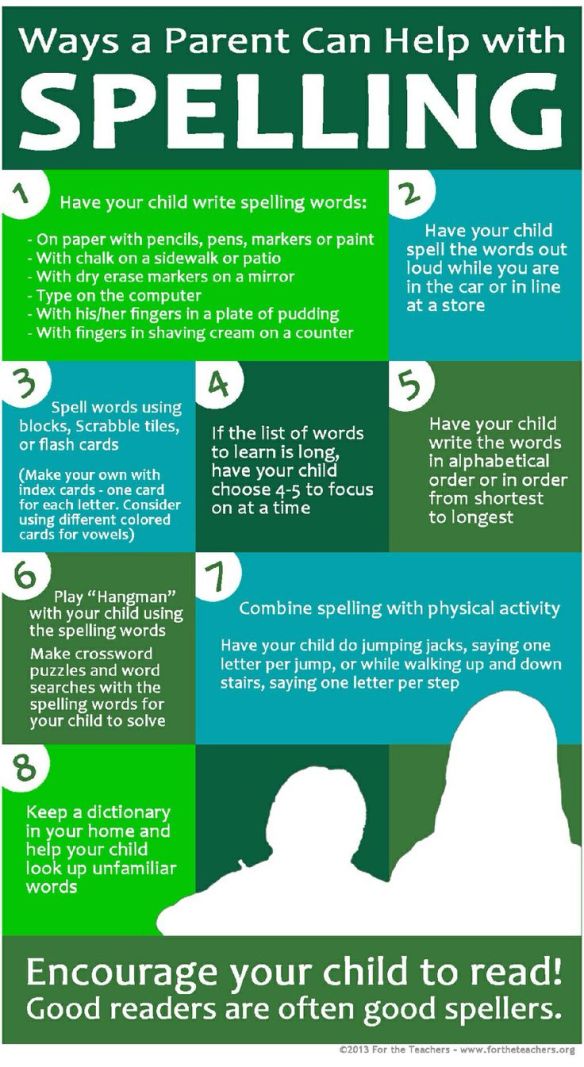
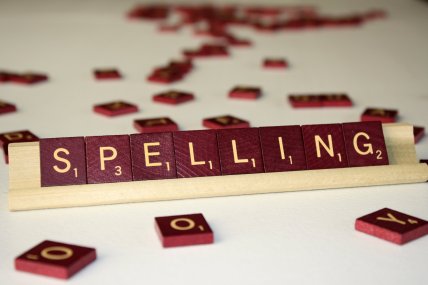
Spelling can be an area of difficulty for students.
Tried and True
FERNALD METHOD FOR SPELLING INSTRUCTION
Purpose
This spelling method is appropriate for students who have difficulty retaining spelling words and learning to spell exception words. Select words that the student uses frequently in writing.
Procedure
1. Write the word to be learned on the chalkboard or on paper.
2. Pronounce the word clearly and distinctly. Ask the student to look at the word and pronounce the word with emphasis on correct pronunciation.
3. Allow time for the student to study the word to develop an image of it. Depending upon the learning style of the student, different senses are emphasized. A student who learns visually tries to picture the word; a student who learns auditorially says the word; and the student who learns kinesthetically traces the word with a finger. The student studies the word until a picture of the word can be formed in his/her mind.
4. When the student indicates that he/she is sure of the word, erase the word and have the student attempt to write the word from memory.
5. Turn the paper over and ask the student to write the word a second time from memory. In daily writing, any misspelled words are marked out entirely and the correct form is written in its place. When a student asks how to spell a word, the teacher writes the word, while pronouncing it. Students are encouraged to make their own dictionaries from words they have learned or words that are especially difficult for them.
Adapted from: Fernald, G. (1943). Remedial techniques in basic school subjects. New York: McGraw-Hill.
Mather, N., & Jaffe, L. (2002). Woodcock-Johnson III: Reports, Recommendations, and Strategies. New York: John Wiley & Sons.
General Principles of Spelling Instruction Even though research and clinical experience indicate that students with reading problems will have a very difficult time learning to spell, it is also clear that instruction can have a significant impact on the development of reading skills. Even though many poor readers may never fully master spelling skills at the highest levels, most can become good enough spellers to make effective use of technology and other spelling aids. In order to provide effective spelling instruction, teachers must have a firm understanding of the ways in which spelling skills develop as well as a strong knowledge of phonology, phonics, orthography, morphology, syntax, semantics.
COORDINATE SPELLING WITH WORD IDENTIFICATION INSTRUCTION. Teach students to spell (encode) the phonetically regular words they are learning to decode in a structured and systematic manner. Teach spelling rules and patterns in coordination with the decoding skills (e.g., teach the rule for doubling s, f, l & z and the -ck for the /k/ sound when closed syllable words are taught).
TEACH SPELLING DIRECTLY WITH GUIDED PRACTICE. Teach spelling patterns, rules, letter-sound associations directly, one skill at a time, with opportunities for guided practice in numerous settings until the skill is well learned.
TEACH ALL LEVELS OF WORD ANALYSIS. Begin with phonemic awareness and include letter sound associations, spelling patterns, onset-rime, rules and morphology.
DISTINGUISH BETWEEN REGULAR AND IRREGULAR WORDS. Always differentiate between regular and irregular words using clear procedures for practicing each. Regular words may be divided into those that can be spelled as they sound (REGULAR) and those that require the application of a rule (RULE WORDS). Students should practice fewer irregular words each lesson than regular. Both should be taught using multisensory strategies.
USE CUES AND MNEMONIC DEVICES. Facilitate recall of skills such as letter formation, letter sound associations, and rules with cues such as pictures, stories, rhymes, gestures, etc.
USE DISCOVERY TEACHING. Use discovery teaching techniques for spelling patterns and rules.
PROVIDE ERROR CORRECTION. Students should be given direct and immediate error correction for spelling errors. The ultimate goal is for the student to independently correct their own errors.
Classroom meetings are an effective way to help build classroom community, establish behavioral expectations and norms, as well as explore social issues that need tending to help continue supporting a thriving learning environment.
Building awareness with all kids to help them better understand the world around them is a should be a priority for schools. It is quite normal for kids to be curious about other children who may use special materials / equipment or behave/ learn differently. It is our role as parents, teachers, and citizens to support the kids in their understanding of these differences. Social Emotional Learning under the guidelines of CASEL should be a pillar in your school plan.
“Andy and His Yellow Frisbee” by Mary Thompson Pre-k -3rd “Be Good to Eddie Lee ” by Virginia Filling Pre-k -3rd “Arnie & the New Kid ” by Nancy Carlson Pre-k -3rd “Danny and the Merry-go-Round” by Nan Holcomb Pre-k -3rd “Let’s Talk about It” by Jennifer Moore-Mallinos Pre-K – 3rd “Leo the Late Bloomer” by Robert Kraus Pre-k -3rd “Fair and Square” by Nan Holcomb 1st – 2nd “I’m like You, You’re like Me” by Cindy Gainer 1st – 2nd “We can do it! by Laura Dwight 1st – 2nd “Rolling Along: The story of Taylor and his Wheelchair” by Jamee Heelan 1st – 5th “Adam and the Magic Marble” by Adam and Carol Buehrens 2nd – 6th
Middle and High School Disability Awareness Book Review
“are you alone on purpose?” By Nancy Werlin. Allison and Adam are twins but Adam has Autism and Allison is gifted. Their parents start going to synagogue and there they meet Harry, the Rabbi’s son, who is a bully and very mean to Adam. When Harry is injured and ends up in a wheelchair he becomes more vulnerable and Allison and Harry become friends. This is a moving story about learning about disabilities but toward the end there are a few cuss words. The story itself is marvelous, but due to some harsh language it is more for high school students.
“Don’t Stop The Music“ by Robert Perske. This novel is exciting and a fun adventure that teaches about physical disabilities and perceptions of able-bodied individuals toward people with disabilities. It has a crime mystery imbedded in a disability awareness book. This book would be wonderful for middle school students as well as young high school students.
“head above water” by S.L. Rottman. This novel is about a 16-year-old girl with an 18-year-old brother with Down Syndrome. Their mother works two jobs to make ends meet and therefore Skye takes on most of the caretaking activities with Sunny. This story highlights how it is having a sibling with a disability. Skye has her first boyfriend and having a brother who she needs to take care of gets in the way of her teenage life. There is some serious storyline as her new boyfriend pressures her to have sex and almost rapes her. It is wonderful how Skye defends herself and sticks up for what she believes in, however, this book would be appropriate for high school only due to the mature storyline.
“Petey” by Ben Mikaelsen. This novel examines the notion that people with physical disabilities are often assumed to have cognitive disabilities when they often do not. This story starts in the early part of the 1900s and follows Petey Corbin though living in an institution and then a nursing home. It is a delightful journey that clearly shows how non-disabled people often are frightened of people with disabilities until they get to know them. It is a particularly good book for boys and is appropriate for both middle and high school students.
“Rules” by Cynthia Lord. This is a Newbery Honor Book and Schneider Family Book Award winner. The story follows a brother with autism and a sister who shares a lot of responsibility for teaching her bother the rules of getting along in a world that does not always have compassion and understanding for someone with autism. Catherine creates rules to help David understand how to live in the world. Catherine also learns a few lessons about other disabilities. This is an excellent book for middle and high school alike.
“Views from our Shoes” Edited by Donald Meyer. This is a compilation of forty-five (45) short narratives of siblings of children with disabilities and how they view living with their siblings.
It is a nice view from children as young as four to as old as eighteen. This book is appropriate for middle and high school students.
“Wish on a Unicorn” by Karen Hesse. This novel uses imagination and wishes to explore the dreams of children living in poverty with a sibling with a disability. The relationship between the children and how protective they are of their sister with a cognitive disability is heart warming. It would be an easy novel to do writing activities with. What would you wish for if you found a unicorn? How would you handle a bully? This story lends itself to middle and high school students.
“The Summer of the Swans” by Betsy Byars. Newberry Award Winner. This novel tells the story of a family that includes a boy with a cognitive disability. This is a short book that easily shows the family dynamics and how it is to be a sibling of a child with a disability. This is a good book for middle school level.
Jones and Jones stated that effective, general rules in a classroom should pertain to (a) health and safety (e.g., “Walk in the classroom, hallways, cafeteria.”), (b) property loss and damage (e.g., “Respect others’ personal property and touch it only with the person’s permission.”), (c) legitimate educational purpose (e.g., “Be on time for class and with all assignments.”), and (d) disruption of the learning process (e.g., “Ask for permission to speak before saying anything in the classroom.”).4 The following are characteristics of good classroom rules regardless of teaching level:
The fewer, the better.
It is wise to keep the number of rules to a minimum. For primary-level students, three or four rules should suffice; for older adolescents, as many as five or six may be necessary. There are ways to cover many activities in a rule by composing it in a broad fashion. Instead of limiting the rule to only the classroom (e.g., “Walk at all times in the classroom.”), a broader rule could state, “Always walk in the classroom, hallways, and cafeteria.”).
Use simple language.
There is no need to write elaborate rules with complex language. Just be direct and simple (e.g., “Raise your hand and wait for the teacher to call on you before speaking.”). If anything, direct, simple language allows for students to remember the rules more easily.
Use a positive voice.
If at all possible, write the rules in a positive format and tone. Try to avoid, “You shall not talk in the classroom without teacher permission,” by stating the same rule as, “Ask for permission to speak before saying anything in the classroom.”
Special context, special rules.
Different rules can be used for special situations and learning stations in the same classroom environment. Rules for using computers in a classroom (e.g., “Always use headphones when listening to music on the computer.”) can be made very specific to that activity and station only.
Create an effective display.
Rules need to be prominently displayed in the classroom or in a special activity area. When students are first learning the rules in the beginning of the school term they need to be bombarded and reminded of them as much as possible. Put them on a bulletin board, duplicate them on the classroom whiteboard, write them on a handout to distribute to class members, and place them in special activity areas (e.g., computer stations). I once witnessed a teacher hanging each classroom rule from the ceiling on both sides of long poster board for all to see in any section of the room. (Now that’s displaying them prominently!)
TouchMath is a multisensory math program that makes critical math concepts appealing and accessible for students who struggle to understand grade-level content.
• Built on the Common Core State Standards • Blended solution of print and technology • Complete instructional core programs for pre-k through 2nd grade • Additional collection of programs for upper grades • Unique, student-friendly manipulatives to reinforce learning and differentiate instruction
Instructions
Touch math is a quick and easy way to help your child learn his/her math facts. Counting on fingers may work for a time, but as the numbers get larger counting on fingers becomes cumbersome and less accurate. To be able to do “touch math” successfully your child needs to be able to count to ten forwards and backwards with ease (please practice often). Touch math uses dots in a certain pattern on numbers that we touch with a pencil to help keep track of our counting. At first this process takes time because you are putting the dots on the numbers, but as your child memorizes the patterns on each number the counting becomes more automatic and the need for the dots subsides. When completing a math fact we put dots on both numbers and we count until we run out of dots. For subtraction we place the first number in our head and count backward until we run out of dots.
A social autopsy is a problem-solving strategy designed to support social skills. Students with difficulties understanding social interactions can use a social autopsy as a way to analyze the social errors they made.
Examples of where social autopsies may be used include:
• Ignoring others’ greetings
• Asking a question in a class without raising hand
• Continuing to talk on the same topic
• Sneezing without covering own mouth
The steps include:
• Identify the error. The student describes to an instructor what happened and identifies what the error was. Identifying the correct emotions about the error can be difficult. The instructor helps the student understand the moment. In addition, the instructor teaches the unspoken rules that govern people’s behavior in a given setting.
• Identify the persons who were hurt by the error. Lack of theory of mind can be an obstruction in identifying others’ feelings or thoughts about the error. Teaching theory of mind may become a central aspect for this step.
• Decide how to correct the error. The student may need to observe the natural setting in which the desired behavior can happen. The instructor helps the student identify what other people do in the same situation and how the consequences can be different.
• Develop a plan that does not cause the error. Based on the identified way to alter the error, the student makes a plan and writes down in the worksheet what to do for the next time.
Remember the Autopsy is:
a supportive, structured, constructive strategy to foster social competence
a problem-solving technique
an opportunity for the child to participate actively in the process
conducted by any significant adult in the child’s environment (teacher, parent, bus driver)
conducted in a familiar, realistic, and natural setting
most effective when conducted immediately after the social error
It is not:
a punishment or scolding
an investigation to assign blame
controlled/conducted exclusively by an adult
a one-time “cure” for teaching the targeted social skill
SOCCSS (Situation, Options, Consequences, Choices, Strategies, Simulations) developed by Jan Roosa. Designed to help individuals understand social situations and interactions, SOCCSS is a step-by-step problem-solving process teaching that choices have consequences. It provides an individual with decision-making techniques, including questioning and choice making. SOCCSS is a perfect intervention to incorporate into a comprehensive program plan. Source
2. Comic strip conversations: Also developed by Carol Gray. Visual symbols such as those found in cartoons often enhance social understanding, turning abstract and elusive events into something tangible that a person can reflect upon. This can help with theory of mind, and to understand the intent behind others actions. In comic strip conversations stick figures with speech and thought bubbles are drawn to illustrate the story while the child is talking. Colors from a color chart illustrate feelings e.g. green equals kind words and thoughts, and red equals mean words and thoughts. Source
3. Social Behavior Mapping-Developed by Michelle Garcia Winner. Social Behavior mapping teaches a student how to Connecting Behavior, Emotions and Consequences Across the Day and is geared for use by parents and professionals to help those with social thinking challenges understand what behaviors are expected and unexpected in a way that makes sense to their way of thinking.
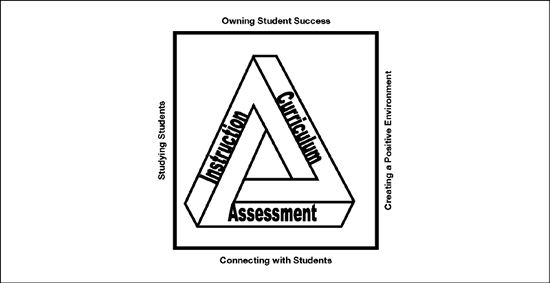
The graphic above demonstrates the “Interdependence of Key Classroom Elements” when executing Differentiated Instruction.
Whether you need motivation to implement differentiated instruction in the classroom or simply need reassurance that it’s working, you’ll find inspiration in these words of wisdom from Tomlinson:
Every child is entitled to the promise of a teacher’s optimism, enthusiasm, time, and energy.
Educators should be champions of every student who enters the schoolhouse doors.
Teachers in the most exciting and effective differentiated classrooms don’t have all the answers. What they do have is optimism and determination.
It is a human birthright to be a learner. There is little we do that is more important.
Like students, teachers grow best when they are moderately challenged. Waiting until conditions are ideal or until you are sure of yourself yields lethargy, not growth.
Teachers change either because they see the light or because they feel the heat.
A great coach never achieves greatness for himself or his team by working to make all his players alike.
Becoming an expert at differentiation is a career-long goal. One step at a time, you will get there.
Don’t feel compelled to grade everything. There’s a time for students to figure things out and a time for judging whether they did, but the two shouldn’t always be the same.
If curriculum and instruction are the heart and limbs of sound teaching, then classroom management is the central nervous system. Without the heart, there is no life, but without the nervous system, there is no function. Source
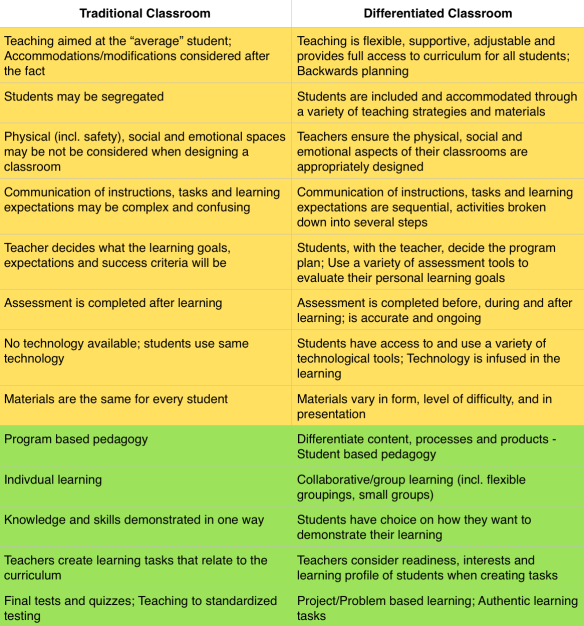
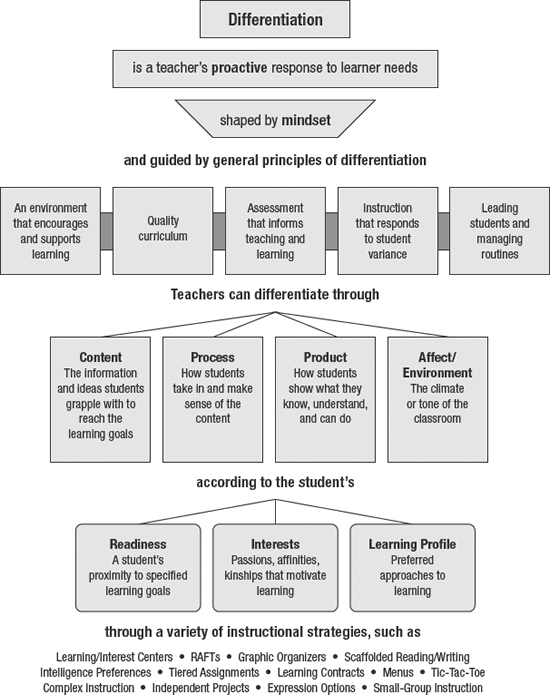
The below graph helps to further describe what the specific aim of Differentiated Instruction.
Scoring the BCSQ may be done either formally or informally. Because these techniques generally represent “best practices,” a higher score on the BCSQ is more desirable and indicates that a teacher is employing the instructional techniques that should facilitate successful inclusion. To get a general score, one may merely total the circled score for each indicator, resulting in a score that ranges from 40 (the lowest possible score) to 200. Bender (1992) reported that a group of 127 general education teachers in Georgia (from Grades 1 through 8) generated a total score of 143 (SD = 19) on this questionnaire. A group of 50 teachers from New Jersey (Grades 3 through 12) generated a score of 139 (SD = 19) on this scale. These general scores may provide some indication of how you provide varied instruction for students with learning disabilities in your class.