Divorce can be hard on kids

parents-arguing-350

In working with kids, I have found varying levels of resiliency with coping with divorce. Most kids that go through a divorce will have needs over time to be addressed. Here are some ideas and resources.

divorce-and-children

Great resources for parents-

Guides, Concepts, and Models

SMILE: An educational program for separating and divorced parents with minor children

Helping Kids Cope with Separation and Divorce

CO-PARENTING RESOURCES

THE FIVE CATEGORIES OF CO-PARENTING

Separated fathers: Fathers, Separation and Co-Parenting

Divorce: A Parents’ Guide for Supporting Children (NASP)

Plans

The Parenting Plan

Impacts on kids

The Effects of Divorce on Children

Long-term Effects of Divorce

Phone Apps

DIVORCEWORKS is designed by two psychologists with 3 decades of experience working with families going through separation and divorce. The app helps people cope with this transition mindfully and in a sane manner.

Teacher Resources

Practical tips for educators

Accommodations/Interventions

Kid Resources

Appreciating the child’s point of view and position is important.

Divorce Brings Many Changes

Divorce is about loss — loss of the family as the child has known it, sometimes even the loss of a familiar home and often many other changes. Loss sometimes brings deep sadness and anger. One thing we can give children is the right to feel — the right to feel sad and angry…the right to feel pain…along with the security of knowing that they still do have adults in their life that will care for them and love them.

The Importance of Rules

Children want to know that some things will not change. They need to know there will still be rules. Rules help them feel secure and loved. Especially if children feel omnipotent, they need firm rules. Even though they may fight the rules, they really do feel more secure knowing that adults are in charge.

Expressing Feelings

Encourage children to use words like “I’m mad” or “I’m sad” when they’re having a tough day. That’s so much better than lashing out at other people or damaging things. One of the most important uses of language is expressing feelings.

Suggest physical activity, like pounding play clay, running in the yard, digging in a pile of dirt, or playing at a playground — all of which can help children drain off some of the tension of angry feelings. You could also encourage drawing pictures, talking to and for a puppet, or making up stories.

Read together children’s books about divorce. Hearing about other children who are dealing with divorce and talking about pictures in a book can often encourage children to bring up their own feelings and concerns.

Even though divorce can be hard to talk about, whatever we can talk about often becomes more manageable. Children need to know that the divorce is not their fault — it’s because of a problem between the grownups. Source

Resources for children

Alpert-Gillis, Linda, and Bernadette Melnyk. Peanut Butter and Jelly Sandwiches Never Change. Rochester, N.Y.: University of Rochester Medical Center, 1993.

Grindley, Sally. A New Room for William. Cambridge, Mass.: Candlewick Press, 2000.

Lansky, Vicki. It’s Not Your Fault, Koko Bear: A Read-Together Book for Parents and Young Children During Divorce. Minnetonka, Minn.: Book Peddlers, 1998.

Stern, Zoe, Evan, and Ellen. Divorce is Not the End of the World. Berkeley, Calif.: Tricycle Press, 1997.

The Abecedarian Reading Assessment


1382370627415

In working through the pre-referral process with teachers to help identify reading issues, we ran across the Abecedarian Reading Assessment. It is free and easy to use and have found that the information it provides helps to guide the interventions we use in the Student Study Team process.

The Abecedarian Reading Assessment was designed to test what research has shown to be the most essential knowledge domains for developing reading skills.  The knowledge domains assessed by the Abecedarian include:


• Letter Knowledge
• Phonological Awareness (Rhyme and Phoneme Identity)
• Phoneme Awareness (First and Last Sounds and Phoneme Segmentation)
• Knowledge of the Alphabetic Principle
• Vocabulary (Production, Synonyms, and Antonyms)
• Decoding (Fluency, Regular Words and Irregular Words)


Written by two reading researchers, Sebastian Wren and Jennifer Watts, the Abecedarian is available for you to download and use for free.  It is a large document (over 50 pages long), so it may take a while to download if you have a telephone connection.  The authors have given permission for this document to be reproduced freely on two conditions:

• The Abecedarian may not be altered.
• Appropriate credit must be given for authorship.

San Diego Quick Reading Assessment

sunset-water-reflection-with-pier1

San Diego Quick Assessment List

The San Diego Quick Assessment List is a very useful, quick way to determine a child’s approximate instructional reading level. It is certainly not a substitute for giving an Individual Reading Inventory with its graded word lists and graded reading passages. However, if a reading teacher merely wants a very easy, quick estimation of a child’s approximate instructional reading level, we have found it to be fairly useful for that purpose. NOTE: The San Diego Quick Assessment List never should be thought of as a substitute for an Individual Reading Inventory, but it can be useful for the purpose for which it was designed.

Administration

1. Type out each list of words on index cards.

2. Begin with a card that is at least two years below the child’s grade-level assignment.

3. Ask the child to read the words aloud to you. If he or she misreads any on the list, drop to easier lists until he or she makes no errors. This indicates the base level.

4. Write down all incorrect responses, or use diacritical marks on your copy of the list. For example, acrid might be read and recorded as acid. Molecule might be recorded a mole (long o) cule.

5. Encourage the child to read words that he or she does not know so that you can identify the techniques he or she uses for word identification. 6. Have the child read from increasingly difficult lists until he or she misses at least three words.

Analysis

1. The list in which the child misses no more than one of the ten words is the level at which he or she can read independently. Two errors indicate the instructional reading level. Three or more errors indicate material that may be too difficult (frustration reading level).

2. An analysis of the child’s errors is useful. Among those that occur with the greatest frequency are the following: Error Example reversal how for who consonant book for look consonant blend string for spring short vowel note for not long vowel rod for road prefix protest for pretext suffix entering for entered miscellaneous (omission of accent, etc.)

3. As with other reading assessment devices, teacher observation of student behavior is very important. Such things as posture, facial expression, and voice quality may signal nervousness, lack of confidence, or frustration while reading

San Diego Quick Reading Assessment (PDF)

San Diego Quick Reading Assessment (PDF) #2

San Diego Quick Reading Assessment (DOC)

Talking with children using engagement and active listening

d0dc26ea1e5e00965aea90375ea955a7

As, I work with children I have noticed that some adults generally refrain from talking to children. I am a big proponent of encouraging adults to talk to kids and forge relationships when they can, the benefits of doing this are great for children in a variety  of ways.

  • Why do teachers talk with children? There are many excellent reasons, such as these:

    • • Children enjoy social conversations with adults.
    • • A few enticing words can encourage children to engage in a particular activity or behavior.
    • • Thought-provoking questions or using new words can extend children’s thinking and curiosity.
    • • Adults can directly answer children’s questions. A great deal of research supports the value of talking with young children.
    • • When adults purposefully talk more with children, children develop larger vocabularies (Hart & Risley, 1999; Hoff & Naigles, 2002).
    • • When children have larger vocabularies, they become better readers in middle childhood (Snow, Burns, & Griffin, 1998).
    • • When adults talk to children with longer, more complex words and sentences, children have higher IQ scores (Hart & Risley, 1999).

• When adults talk with children in a responsive and sensitive way, they encourage children’s social and emotional development (Ensor & Hughes, 2008; Harris, 2005). In general, talking with young children encourages development in many areas: spoken language, early literacy, cognitive development, social skills, and emotional maturity. Speaking with children in increasingly complex and responsive ways does this even better. Source

So what to do?

What Can Adults Do?

Adults can play a major role in children’s ability to identify, understand, and express emotions in a healthy way. The following strategies are key in fostering emotional literacy in young children:

Express Your Own Feelings. One way to help children learn to label their emotions is to have healthy emotional expression modeled for them by the adults in their lives. For example, a teacher who knocked over all the glitter can say, “Oh boy, is that frustrating. Oh well, I’d better take a deep breath and figure out how to clean it up.” Or a parent who just got word that she got a promotion at work can say, “Wow! I am so excited about this! I feel proud of myself for working so hard.” Parents, teachers, and child care providers can make a point to talk out loud about their feelings as they experience them throughout the day.

Label Children’s Feelings. As adults provide feeling names for children’s emotional expressions, a child’s feeling vocabulary grows. Throughout the day, adults can attend to children’s emotional moments and label feelings for the children. For example, as a child runs for a swing, another child reaches it and gets on. The first child begins to frown. The teacher approaches her and says, “You look a little disappointed about that swing.” Or a boy’s grandmother surprises him by picking him up at child care. The boy screams, “Grandma!” and runs up to hug her. The child care provider says, “Oh boy, you look so happy and surprised that your grandma is here!” As children’s feeling vocabulary develops, their ability to correctly identify feelings in themselves and others also progresses.

Play Games, Sing Songs, and Read Stories with New Feeling Words. Adults can enhance children’s feeling vocabularies by introducing games, songs, and storybooks featuring new feeling words. Teachers and other caregivers can adapt songs such as “If you’re happy and you know it” with verses such as “If you’re frustrated and you know it, take a breath”; “If you’re disappointed and you know it, tell a friend”; or “If you’re proud and you know it, say ‘I did it!’” The following are some examples of games young children can play.

• Adults can cut out pictures that represent various feeling faces and place them in a container that is passed around the circle as music plays. When the music stops, the child holding the container can select a picture designating an emotion and identify it, show how they look when they feel that way, or describe a time when he or she felt that way. To extend this fun activity, give the children handheld mirrors that they can use to look at their own feeling faces.

• Children can look through magazines to find various feeling faces. They can cut them out and make a feeling face collage. Adults can help the children label the different feeling faces.

• Children and adults can play “feeling face charades” by freezing a certain emotional expression and then letting others guess what the feeling is. To extend this activity, ask the children to think of a time that they felt that way.

• In the mornings, have children “check in” by selecting a feeling face that best represents their morning mood. At the end of the day, have children select again, and then talk about why their feeling changed or stayed the same.

• Finally, the teacher can put feeling face pictures around the room. Children can be given child-size magnifying glasses and told to walk around looking for different feeling faces. When they find one, they can label it and tell about a time they felt that way. With a little creativity, teachers and other caregivers can play, adapt, or develop new games, songs, and stories to teach feeling words.  Source

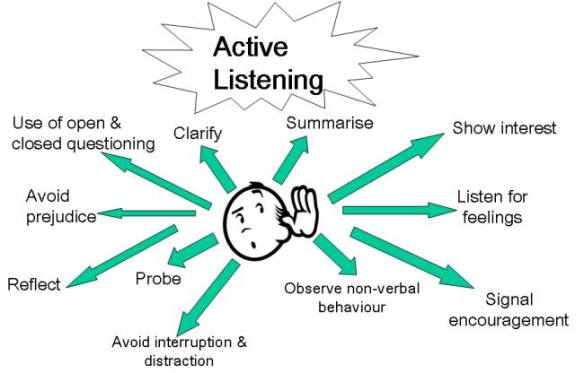
Active Listening has some good ideas for promoting good communication.

e02db5325c95f71ecc923d1d7bba479e

Active Listening

The most common problem in communication is not listening! A Chinese symbol for “To Listen” is shown below.  It is wise beyond the art. The left side of the symbol represents an ear. The right side represents the individual- you. The eyes and undivided attention are next and finally there is the heart.

chineseletter

This symbol tells us that to listen we must use both ears, watch and maintain eye contact, give undivided attention, and finally be empathetic.  In other words we must engage in active listening!

Active listening is a skill taught to teachers and police officers, counselors, ministers, rabbis and priests. It is a skill we would all do better having learned, practiced. To begin being an active listener we must first understand the four rules of active listening.

The Four Rules of Active Listening

1. Seek to understand before you seek to be understood.

2. Be non judgmental

3. Give your undivided attention to the speaker

4. Use silence effectively

Let’s explore the rules of active listening.

1. Seek to understand before seeking to be understood. When we seek to understand rather than be understood, our modus operandi will be to listen. Often, when we enter into conversation, our goal is to be better understood. We can be better understood, if first we better understand. With age, maturity, and experience comes silence. It is most often a wise person who says little or nothing at the beginning of a conversation or listening experience. We need to remember to collect information before we disseminate it. We need to know it before we say it.
2. Be non judgmental. Empathetic listening demonstrates a high degree of emotional intelligence. There is a reason kids do not usually speak with adults about drugs, sex, and rock and roll. The kids already know what the adults have to say. Once a child knows your judgment, there is little reason to ask the question unless the intention is to argue. If we would speak to anyone about issues important to them, we need to avoid sharing our judgment until we have learned their judgment. This empathetic behavior is an indicator of emotional intelligence as described in Chapter 3.
  1. Give your undivided attention to the speaker.The Chinese symbol that we used to describe listening used the eyes and undivided attention. Absolutely important is dedicating your undivided attention to the speaker if you are to succeed as an active listener. Eye contact is less important. In most listening situations people use eye contact to affirm listening. The speaker maintains eye contact to be sure the listener or listeners are paying attention. From their body language the speaker can tell if he is speaking too softly or loudly, too quickly or slowly, or if the vocabulary or the language is inappropriate. Listeners can also send messages to speakers using body language. Applause is the reason many performers perform. Positive feedback is an endorphin releaser for the giver and the sender. Eye contact can be a form of positive feedback. BUT, eye contact can also be a form of aggression, of trying to show dominance, of forcing submissive behavior. All primates use eye contact to varying degrees. We should be careful how we use it when listening. If we want to provide undivided attention to a child, a better way to show your attention is to do a “walk and talk”.
  2. Use silence effectively.The final rule for active or empathic listening is to effectively use silence. To often a truly revealing moment is never brought to fruition because of an untimely interruption. Some of the finest police interrogators, counselors, teachers and parents learn more by maintaining silence than by asking questions. As an active or empathic listener, silence is a very valuable tool. DO NOT interrupt unless absolutely necessary. Silence can be painful. It is more painful for a speaker than for a listener. If someone is speaking, and we want them to continue talking, we do not interrupt. Rather, we do provide positive feedback using body language, eye contact, and non word sounds like “umh, huh”. Silence is indeed golden especially when used to gather information as a listener. Source

Separation Anxiety and School Refusal

getty_girl_mom_stress_sick_stomachache_large_kidstock

Recently, my little girl started in a home daycare. Initially, she struggled with separation anxiety.  She has since settled down (whew!). This post has some good pointers on Separation Anxiety.

Daycare/ Preschool

Easing the Separation Process for Infants, Toddlers, and Families

Helping Your Toddler with Separation Anxiety

Positive Goodbyes

Transitional Kindergarten and Kindergarten

Understanding school refusal

-A child may exhibit each behavior on this spectrum at different times

Common symptoms that could signal school refusal behavior

INTERNALIZING/COVERT SYMPTOM EXTERNALIZING/OVERT SYMPTOM
Depression Aggression
Fatigue/tiredness Clinging to an adult
Fear and panic Excessive reassurance-seeking behavior
General and social anxiety Noncompliance and defiance
Self-consciousness Refusal to move in the morning
Somatization Running away from school or home
Worry Temper tantrums and crying

Source

School Refusal: Information for Educators (NASP)

School Refusal Behavior: From Terminology to Treatment

Working Through School Refusal

what can I do when my child refuses to go to school

Anxiety and School Refusal PPT

Dealing With Separation Anxiety In Teens

Criteria for Differential Diagnosis of School Refusal and Truancy

SCHOOL REFUSAL TRUANCY

Severe emotional distress about attending school; may include anxiety, temper tantrums, depression, or somatic symptoms.

Lack of excessive anxiety or fear about attending school.

Parents are aware of absence; child often tries to persuade parents to allow him or her to stay home.

Child often attempts to conceal absence from parents.

Absence of significant antisocial behaviors such as juvenile delinquency.

Frequent antisocial behavior, including delinquent and disruptive acts (e.g., lying, stealing), often in the company of antisocial peers.

During school hours, child usually stays home because it is considered a safe and secure environment.

During school hours, child frequently does not stay home.

Child expresses willingness to do schoolwork and complies with completing work at home.

Lack of interest in schoolwork and unwillingness to conform to academic and behavior expectations.

How parents can help children at home

There are things parents can do to help children and adolescents learn to manage their anxious feelings. Parent support plays a key role in helping kids learn to cope independently. Try these strategies at home to help your child succeed outside of the home:

-Make a plan to help your child transition to school in the morning (arrive early, act as the teacher’s helper before the other kids arrive, get some exercise on the playground before the bell rings)

-Help your child reframe anxious thoughts by coming up with a list of positive thoughts (it even helps to write these on cards and put them in the backpack)

-Write daily lunchbox notes that include positive phrases

-Avoid overscheduling. Focus on playtime, downtime, and healthy sleep habits

-Alert your child to changes in routine ahead of time

-Empathize with your child and comment on progress made

– Teach relaxation strategies

Kids need to learn a variety of tools to use when feeling anxious and overwhelmed. It’s nearly impossible to use adaptive coping strategies when you’re dealing with intense physical symptoms of anxiety, so the first step is with work on learning to calm the anxious response.

  • Deep breathing is the best way to calm rapid heart rate, shallow breathing and feeling dizzy. Teach your child to visualize blowing up a balloon while engaging the diaphragm in deep breathing. Count your child out to help slow the breathing (4 in, 4 hold, 4 out).
  • Guided imagery: Your child can take a relaxing adventure in her mind while engaging in deep breathing. Tell a quick story in a low and even voice to help your child find her center.
  • Progressive muscle relaxation: Anxious kids tend to tense their muscles when they’re under stress. Teach your child to relax her muscles and release tension beginning with her hands and arms. Make a fist and hold it tight for five seconds, then slowly release. Move on to the arms, neck and shoulders, and feet and legs.

– Teach cognitive reframing

Kids with social anxiety disorder are often overwhelmed by negative beliefs that reinforce their anxious thoughts. Their beliefs tend to fall into the following categories:

  • Assuming the worst case scenario
  • Believing that others see them through a negative lens
  • Overreacting
  • Personalizing

Teach your child to recognize negative thoughts and replace them with positive ones. If your child tends to say things like, “My teacher thinks I’m stupid because I’m bad at reading,” help him recognize the negative thought, ground it in reality (a teacher’s job is to help kids learn not judge them on what they already know), and replace it with a positive thought (“I’m having a hard time reading but my teacher will help me get better.”)

– Teach problem-solving skills

Children with social anxiety disorders tend to become masters of avoidance. They do what they can to avoid engaging in situations that cause the most anxiety. While this might seem like the path of least resistance, it can actually make the social anxiety worse over time.

Teach your child to work through feelings of fear and anxiety by developing problem-solving skills. If a child fears public speaking, for example, she can learn to practice several times at home in front of a mirror, have someone videotape her and watch it back, find the friendly face in the room and make eye contact, and use deep breathing to calm anxious feelings.

Help your child identify her triggers and brainstorm potential problem-solving strategies to work through those triggers.

– Work on friendship skills

While you can’t make friends for your child, you can help your child practice friendship skills. Practice these skills using role play and modeling to help your child feel at ease with peers:

  • Greetings
  • Sliding in and out of groups
  • Conversation starters
  • Listening and responding
  • Asking follow up questions/making follow up statements

Books

What to Do When You Worry Too Much: A Kid’s Guide to Overcoming Anxiety (What to Do Guides for Kids) by Dawn Huebner

The Kissing Hand by Audrey Penn

Wemberly Worried by Kevin Henkes

First Day Jitters by Julie Danneberg

Llama Llama Misses Mama by Anna Dewdney

Love You All Day Long by Francesca Rusackas

When I Miss You by Cornelia Spelman

If things progress-

How to get help for your child

The best treatment to help children struggling with school refusal includes a team approach. While children tend to focus on what they don’t like or worry about at school, the truth is that the underlying issues can include stress at home, social stress, and medical issues (a child who struggles with asthma, for example, might experience excessive worry about having an asthma attack at school). It helps to have a strong team that includes the classroom teacher, family, a school psychologist (if available), and any specialist working with the child outside of school.

  1. Assess: The first step is a comprehensive medical and psychological evaluation. Given that school refusal is generally related to an underlying anxiety or depressive disorder, it’s important to get to the root of the problem and begin there. This will likely include both family and teacher questionnaires or interviews.
  2. Cognitive Behavioral Therapy: This highly structured form of therapy helps children identify their maladaptive thought patterns and learn adaptive replacement behaviors. Children learn to confront and work through their fears.
  3. Systemic desensitization: Some children struggling with school refusal need a graded approach to returning to school. They might return for a small increment of time and gradually build upon it.
  4. Relaxation training: This is essential for children struggling with anxiety. Deep breathing, guided imagery, and mindfulness are all relaxation strategies that kids can practice at home and utilize in school.
  5. Re-entry plan: The treatment team creates a plan to help the student re-enter the classroom. Younger children might benefit from arriving early and helping the teacher in the classroom or helping at the front desk. The plan also includes contingencies to help the student during anxious moments throughout the day (i.e., using fidget toys, taking a brain break to color, a walk outside with a teacher’s aide, etc.)
  6. Routine and structure: Anxious children benefit from predictable home routines. Avoid over-scheduling, as this can increase stress for anxious kids, and put specific morning and evening routines in place.
  7. Sleep: Sleep deprivation exacerbates symptoms of anxiety and depression. It also makes it difficult to get up and out to school in the morning. Establish healthy sleep habits and keep a regular sleep cycle, even during holidays and on the weekends.
  8. Peer buddy: Consider requesting a peer buddy for recess, lunch, and other less structured periods as anxiety can spike during these times.
  9. Social skills training: Many students who struggle with making and keeping friends feel overwhelmed in the school environment. Social skills groups can help kids learn to relate to their peers and feel comfortable in larger groups.

There isn’t a quick fix for school refusal. You might see periods of growth only to experience significant setbacks following school vacations or multiple absences due to physical illness. Acknowledge your child’s difficulty, engage in open and honest communication about it, empathize with your child, and pile on the unconditional love and support.

References

https://www.psycom.net/social-anxiety-how-to-help-kids

http://www.educationandbehavior.com/strategies-schools-help-children-separation-anxiety/

https://www.psychologytoday.com/us/blog/worry-free-kids/201710/how-help-child-overcome-school-refusal

Autism and the Holidays

Twelve Tips for Helping Individuals with Autism Have a Happy Holiday Season

While many happily anticipate the coming holiday season, families of people on the autism spectrum also understand the special challenges that may occur when schedules are disrupted and routines broken. Our hope is that by following these few helpful tips, families may lessen the stress of the holiday season and make it a more enjoyable experience for everyone involved. The following tips were developed with input from the Autism Society, the Indiana Resource Center for Autism, Easter Seals Crossroads, the Sonya Ansari Center for Autism at Logan and the Indiana Autism Leadership Network..

1. Preparation is crucial for many individuals. At the same time, it is important to determine how much preparation a specific person may need. For example, if your son or daughter has a tendency to become anxious when anticipating an event that is to occur in the future, you may want to adjust how many days in advance you prepare him or her. Preparation can occur in various ways by using a calendar and marking the dates of various holiday events, or by creating a social story that highlights what will happen at a given event.

2. Decorations around the house may be disruptive for some. It may be helpful to revisit pictures from previous holidays that show decorations in the house. If such a photo book does not exist, use this holiday season to create one. For some it may also be helpful to take them shopping with you for holiday decorations so that they are engaged in the process. Or involve them in the process of decorating the house. And once holiday decorations have been put up, you may need to create rules about those that can and cannot be touched. Be direct, specific and consistent.

3. If a person with autism has difficulty with change, you may want to gradually decorate the house. For example, on the first day, put up the Christmas tree, then on the next day, decorate the tree and so on. And again, engage them as much as possible in this process. It may be helpful to develop a visual schedule or calendar that shows what will be done on each day.

4. If a person with autism begins to obsess about a particular gift or item they want, it may be helpful to be specific and direct about the number of times they can mention the gift. One suggestion is to give them five chips. They are allowed to exchange one chip for five minutes of talking about the desired gift. Also, if you have no intention of purchasing a specific item, it serves no purpose to tell them that maybe they will get the gift. This will only lead to problems in the future. Always choose to be direct and specific about your intentions.

5. Teach them how to leave a situation and/or how to access support when an event becomes overwhelming. For example, if you are having visitors, have a space set aside for the child as his/her safe/calm space. The individual should be taught ahead of time that they should go to their space when feeling overwhelmed. This self-management tool will serve the individual into adulthood. For those who are not at that level of self-management, develop a signal or cue for them to show when they are getting anxious, and prompt them to use the space. For individuals with more significant challenges, practice using this space in a calm manner at various times prior to your guests’ arrival. Take them into the room and engage them in calming activities (e.g., play soft music, rub his/her back, turn down the lights, etc.). Then when you notice the individual becoming anxious, calmly remove him/her from the anxiety-provoking setting immediately and take him/her into the calming environment.

6. If you are traveling for the holidays, make sure you have their favorite foods, books or toys available. Having familiar items readily available can help to calm stressful situations. Also, prepare them via social stories or other communication systems for any unexpected delays in travel. If you are flying for the first time, it may be helpful to bring the individual to the airport in advance and help him/her to become accustomed to airports and planes. Use social stories and pictures to rehearse what will happen when boarding and flying.

7. Know your loved one with autism and how much noise and activity they can tolerate. If you detect that a situation may be becoming overwhelming, help them find a quiet area in which to regroup. And there may be some situations that you simply avoid (e.g., crowded shopping malls the day after Thanksgiving).

8. Prepare a photo album in advance of the relatives and other guests who will be visiting during the holidays. Allow the person with autism access to these photos at all times and also go through the photo album with him/her while talking briefly about each family member.

9. Practice opening gifts, taking turns and waiting for others, and giving gifts. Role play scenarios with your child in preparation for him/her getting a gift they do not want. Talk through this process to avoid embarrassing moments with family members. You might also choose to practice certain religious rituals. Work with a speech language pathologist to construct pages of vocabulary or topic boards that relate to the holidays and family traditions.

10. Prepare family members for strategies to use to minimize anxiety or behavioral incidents, and to enhance participation. Help them to understand if the person with autism prefers to be hugged or not, needs calm discussions or provide other suggestions that will facilitate a smoother holiday season. If the individual becomes upset, it might also be helpful to coach others to remain calm and neutral in an effort to minimize behavioral outbursts.

11. If the person with autism is on special diet, make sure there is food available that he/she can eat. And even if they are not on a special diet, be cautious of the amount of sugar consumed. And try to maintain a sleep and meal routine.

12. Above all, know your loved one with autism. Know how much noise and other sensory input they can take. Know their level of anxiety and the amount of preparation it may take. Know their fears and those things that will make the season more enjoyable for them.

Don’t stress. Plan in advance. And most of all have a wonderful holiday season! Source

Articles for Parents

Great Resource- Thriving During the Holidays

Reducing Holiday Stress for Families of Children with Autism

Holiday Road Trips: Five Tips to Reduce Stress

7 TIPS FOR A HAPPY HOLIDAY SEASON WITH YOUR LOVED ONE AFFECTED BY AUTISM

Preparing for the Holidays with Autism

Dealing with the “Back-to-School” Blues: Tips for Parents of Asperger’s Kids

Back to School with ASD

Social Stories

Visiting Family at Christmas

Going to Visit Santa

What to Expect at Christmas (PowerPoint) edit to meet your needs*

Airplane Trip (good example)

page01

Holiday/Winter Break Social Stories & Visual Supports

Calendar Icons

Christmas Presents A social narrative to help individuals understand social expectations when receiving presents.


Grade Retention

03kind600-400x176

Grade retention or grade repetition is the process of having a student repeat an educational course, usually one previously failed. Students who repeat a course are referred as “repeaters”. Repeaters can be referred to as having been “held back”. Source

A Handout for Educational Professionals.

A common misperception is that giving a student the “gift” of another year in the same grade will allow the child time to mature (academically and socially); however, grade retention has been associated with numerous deleterious outcomes. Without specific targeted interventions, most retained students do not “catch up.”

Research Regarding Retention:

Temporary gains. Research indicates that academic improvements may be observed during the year the student is retained, however, achievement gains typically decline within 2–3 years of retention.

Negative impact on achievement and adjustment. Research has shown that grade retention is associated with negative outcomes in all areas of student achievement (e.g., reading, math, oral and written language) and social and emotional adjustment (e.g., peer relationships, self-esteem, problem behaviors, and attendance).

Negative long-term effects. By adolescence, experiencing grade retention is associated with emotional distress, low self-esteem, poor peer relations, cigarette use, alcohol and drug abuse, early onset of sexual activity, suicidal intentions, and violent behaviors.

Retention and dropout. Students who have been retained are much more likely to drop out of school.

Consequences during adulthood. As adults, individuals who repeated a grade are more likely than adults who did not repeat a grade to be unemployed, living on public assistance, or in prison.

What can educational professionals do to help?

It is imperative that we implement effective strategies that enable at-risk students to succeed. Addressing problems early improves chances for success. Consider the following:

• Identify the unique strengths and needs of the student.

• Implement effective research-based teaching strategies (e.g., Preschool Programs, Access to School-Wide Evidence-Based Programs, Summer School and After School Programs, Looping and Multi-Aged Classrooms, School-Based Mental Health Programs, Parental Involvement, Early Reading Programs, Direct Instruction, Mnemonic Strategies, Curriculum Based Measurement, Cooperative Learning, Behavior and Cognitive Behavior Modification Strategies)

• Identify learning and behavior problems early to help avoid the cumulative effects of ongoing difficulties. • Discuss concerns and ideas with parents and other educational professionals at the school.

• Provide structured activities and guidance for parents or other adults to work with the child to help develop necessary skills.

• Collaborate with other professionals in a multidisciplinary student-support team.

This handout for educational professionals was adapted from a handout developed for teachers. Jimerson, S., Woehr, S., Kaufman, A., & Anderson, G. (2004). Grade retention and promotion: Important information for educators. In A.S. Canter, S.A. Carroll, L. Paige, & I. Romero (Eds.), Helping Children at Home and School: Handouts From Your School Psychologist (2nd ed., Section 3, pp. 61– 64). Bethesda, MD: National Association of School Psychologists. Source

What Research Says About… / Grade Retention

Grade Retention in Elementary Schools: Policies, Practices, Results, and Proposed New Directions

SPEAKING OUT: RETENTION HAS NO PLACE IN AMERICA’S SCHOOLS

Is Retaining Students in the Early Grades Self-Defeating?

Research Findings on Retention from the National Association of School Psychologists

GRADE RETENTION AND PROMOTION: INFORMATION FOR PARENTS

Migrant Students and Trauma

Some of our students who’s parents are migrant farm workers are preparing to go back to Mexico over the Winter School break. Some of our students may encounter an event that could cause undo stress and trauma. This post is gear towards gaining understanding around how to support trauma at school.

Undocumented immigrant children and youth are frequently subject to particularly traumatic experiences, including racial profiling, ongoing discrimination, exposure to gangs, immigration raids, the arbitrary checking of family members’ documentation status, forcible removal or separation from their families, placement in detention camps or in child welfare, and deportation. Source

Teachers are also affected by the stress of some of the fall out that occurs in migration and immigration issues. Here is a quick conclusion to a recent study of those who work with migrant immigrants.

” Although there is an increased interest regarding factors that contribute to immigrants’ mental health, little attention has been given to the psychological needs of Mexican immigrants affected by deportation. Research focused on this population is necessary in order to better understand and generate appropriate interventions for working with Mexican immigrants affected by deportation. Similarly, experiences of professionals with a history of working with this population may identify potential challenges and provide recommendations for working with this population. Furthermore, it is important that educators and mental health training programs offer additional training in multiculturalism to those students interested in working with this population.” 

The Heart of Learning and Teaching: Compassion, Resiliency, and Academic Success

Teacher toolkit on trauma

Preliminary Adaptations for Working with Traumatized Latino/Hispanic Children and their Families

When Immigration Is Trauma: Guidelines for the Individual and Family Clinician

Partnering with Parents and Families to Support Immigrant and Refugee Children at School

How Today’s Immigration Enforcement Policies Impact Children, Families, and Communities- A View from the Ground

WHEN PARENTS ARE DEPORTED OR INCARCERATED

Helping immigrant children heal

Immigrant Children and PTSD PowerPoint

Responding to Students with PTSD in Schools

How to Support Refugee Students in the ELL Classroom

Mexico’s Violence and Posttraumatic Stress Disorder in Immigrant Children: A Call for Collaboration Among Educators

Evidence-Based Practices with Latino Youth: A Literature Review

Migrant Health Issues Mental Health and Substance Abuse

Brochures/Fact Sheets

Books

 Migrant Farmworker Families: Books for Kids

What teachers can do to support students living in poverty

poverty-hurts

Poverty is a difficult obstacle for learning students.

A New Majority Research Bulletin: Low Income Students Now a Majority in the Nation’s Public Schools

Percent-of-Low-Income-Students-in-PS-2015-01

What you can do

• Operate like NASA – failure is not an option. If you cannot connect people or resolve a poverty issue, who in your network or community might be able to? Use an “If not me, then who?” approach.

• Build stronger partnerships. Poverty is complex and requires a comprehensive community-wide approach. Connect with other businesses, organizations, and individuals in the neighborhood who can help. Rely on your “full resource backpack,” an inventory of who in your community may be able to assist people in moving out of poverty.

• Learn proven strategies. In spite of the lack of education in our country about poverty, there are theories that provide strategies for breaking the iron cage of poverty. The following page outlines five theories and provide suggestions for how educators and others can break the barriers of poverty.

• Mentor. Take the time to build meaningful relationship with students

Source

aec-poverty

You can help your students who live in poverty by implementing some of these suggestions:

• When you suspect that their peers are taunting disadvantaged students, act quickly to stop the harassment.

• Students who live in poverty have not been exposed to broadening experiences such as family vacations, trips to museums, or even eating in restaurants. Spend time adding to their worldly experience if you want poor students to connect their book learning with real-life situations.

• Listen to your disadvantaged students. They need a strong relationship with a trustworthy adult in order to succeed.

• Work to boost the self-esteem of students who live in poverty by praising their school success instead of what they own.

• Provide access to computers, magazines, newspapers, and books so low-income students can see and work with printed materials. School may be the only place where they are exposed to print media.

• Keep your expectations for poor students high. Poverty does not mean ignorance.

• Don’t make comments about your students’ clothes or belongings unless they are in violation of the dress code.

• Students who live in poverty may not always know the correct behaviors for school situations. At home, they may function under a different set of social rules. Take time to explain the rationale for rules and procedures in your classroom.

• Be careful about the school supplies you expect students to purchase. Keep your requirements as simple as you can for all students.

• Arrange a bank of shared supplies for your students to borrow when they are temporarily out of materials for class.

• Do not require costly activities. For example, if you require students to pay for a field trip, some of them will not be able to go.

• If you notice that a student does not have lunch money, check to make sure that a free lunch is an option for that child.

• Be very sensitive to the potential for embarrassment in even small requests for or comments about money that you make. For example, if you jokingly remark, “There’s no such thing as a free lunch,” you could embarrass one of your low-income students.

• Make it clear that you value all of your students for their character and not for their possessions

Adapted from First-Year Teacher’s Survival Guide.

Source

Educating Everybody’s Children (Book)

Poverty Myth (Article)

The Effects of Poverty on Teaching and Learning (great read)

Students in Poverty

Improving Education for Students with Learning Disabilities Living in Poverty

Concise Handout on Student Poverty*

Teaching Through Trauma: How poverty affects kids’ brains (Listen to the audio clip)

Effects of Poverty What Teachers Should Know (PowerPoint)

Teaching with Poverty in Mind (Book Review on PowerPoint)

Slow Learners

every-child-deserves-a

Children with less ability, such as slow learners or students with low average intelligence, could not be expected to learn as well because their potential was less and, therefore, their difficulties in learning could be explained (Meyer, 2000).

Helping Slow Learners Succeed

In this Principal Leadership article, McGill University professor Steven Shaw focuses on slow learners, many of whom, he says, fall through “one of the largest and most pervasive cracks in the educational system.” Students with borderline intelligence, who make up about 14 percent of the student population, don’t quality for special education but often do poorly in regular classrooms and high-stakes tests. “Standard systems and supports are often ineffective – even counterproductive – because they fail to meet students’ specific learning needs and instead create a cycle of failure,” says Shaw. “By the time many of these students get to high school, their academic difficulties and related self-perceptions and attitudes toward learning are entrenched.” They are disproportionately kept back, get in trouble, drop out, and are underemployed, unemployed, or incarcerated. Still, many slow learners graduate from high school and complete postsecondary education.

Shaw lists some keys to success:

– Making sure they have close relationships with one or two staff members;

– Maximizing academically engaged time and providing extra time on task;

– Breaking down lessons and tasks into manageable chunks;

– Presenting information concretely versus abstractly and relating it to real-world experiences;

– Using hands-on activities and computer-assisted instruction to reinforce learning;

– Helping students relate new material to previous learning and organize it for effective memory storage;

– Providing repetition and frequent practice of discrete skills applied to different challenges;

– Helping students generalize skills and knowledge and apply them to new situations;

– Providing a variety of ways to demonstrate competence;

– Pairing students with peer mentors; – Helping them set long-term goals and manage their time;

– Helping them develop academic motivation by getting them involved in activities they enjoy and in which they are successful;

– Maintaining high expectations and rewarding genuine effort.

It’s a myth that slow learners need slow-paced instruction, says Shaw. “Slower-paced instruction is a surefire recipe for falling further behind,” he says. “Students with borderline intellectual functioning require more practice opportunities in the same amount of time as their average-ability peers. An appropriately paced classroom is one that is well organized, that uses computer-assisted instruction, and is taught by a teacher who has high expectations for rapid work completion. This type of environment enables slow learners to learn the discrete facts they need to know to overcome their limitations in generalization. Computer-assisted instruction makes learning basic skills automatic, which is essential to gaining fluency.” “Rescuing Students from the Slow Learner Trap” by Steven Shaw in Principal Leadership, February 2010 (Vol. 10, #6, p. 12-16), no e-link available

Source

Slow Learners an Academic Guide

Great Teacher Handouts on Supporting Slow Learners in the classroom

Slow Learner PowerPoint

Slow Learner’s in the context of BLOOM’S PowerPoint

Grade Retention and Borderline Intelligence: The Social–Emotional Cost

Slow Learner FAQ

What’s the Difference — Slow Learner or Learning Disabled?

Slow Learners: Role of Teachers and Guardians in Honing their Hidden Skills

STRATEGIES FOR “SLOW LEARNERS”

Teacher Step By Step Strategies (Slow Learners)

Staff Development for Teaching Slow Learners