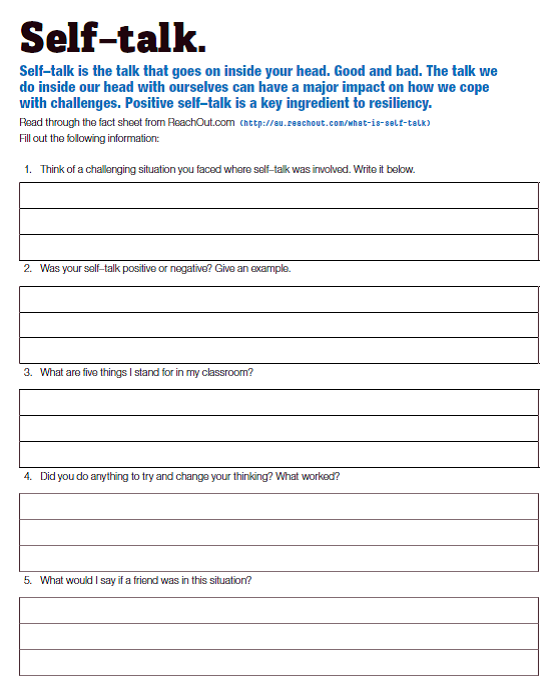
Your thoughts are important when learning

Negative self talk can plague a student’s success in the classroom.

Worksheet: here

Five Key Points

In What Students Say to Themselves: Internal Dialogue and School Success (Thousand Oaks, CA: Corwin Press, 2000), William Watson Purkey suggests the following five points to keep in mind as you try to shape students’ self-talk:

  1. What significant people think about students and how they act toward students influences how students define themselves.
  2. How students define themselves in their internal dialogue influences their academic success and failure.
  3. Everything the school does and the way things are done influences what students say to themselves.
  4. Altering how students define themselves involves altering the total school environment.
  5. The task of the school is to structure experiences that reduce crippling self-talk while inviting students to define themselves in essentially positive and realistic ways. (p. 77)

Source

Teacher Notes here

One path to get to better academic thought is through meta-cognitive strategies.

Metacognition is one’s ability to use prior knowledge to plan a strategy for approaching a learning task, take necessary steps to problem solve, reflect on and evaluate results, and modify one’s approach as needed. It helps learners choose the right cognitive tool for the task and plays a critical role in successful learning.

Fogarty (1994) suggests that metacognition is a process that spans three distinct phases, and that, to be successful thinkers, students must do the following:

  1. Develop a plan before approaching a learning task, such as reading for comprehension or solving a math problem.
  2.  Monitor their understanding; use “fix-up” strategies when meaning breaks down.
  3.  Evaluate their thinking after completing the task.
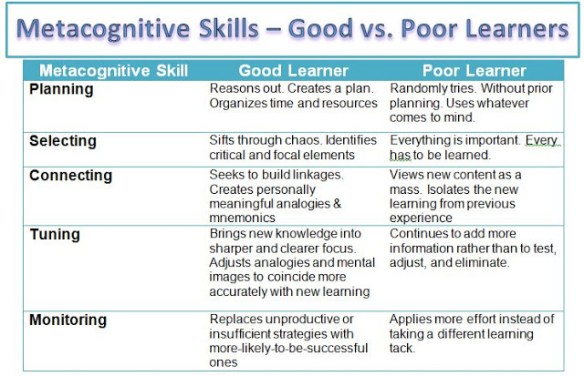
So when we look at eliciting meta-cognition we really are trying to amplify curiosity. While giving a nod to scientific thought and inquiry as a way to try and fail, while being more accepting of our learning because we see the the failure as part of the evaluative process of learning.

Deeper reading: here and here

Dr. Ellen Langer on Mindfullness and Mindlessness

So, as you may or may not know I am addicted to Krista Tippitt’s podcast On Being. She recently interviewed Dr. Ellen Langer on Mindfulness and Mindlessness. I was expecting something deeply connected to Buddhism with some science. This was not the case. Come to find out that for 35 or so years Dr. Langer has dedicated most of her studies toward Mindfuless and Mindlessness experiments.

The key features of what I liked about this very worthy subject is that language and perspective can largely effect us and the outcomes we seek. She proves through science that if we think in terms that reflect the positive nature of the actions we take, many of negative side effects tend to disappear. She suggests that if we allow ourselves to notice new aspects of people or topics it helps to keep our world fresh and open to possibilities, which in turn keeps our brains more in-tune and happy for lack of a better explanation.

Podcast: 

Here is a video that is equally as engaging as the podcast:

Mind set

Part of the job of being a School Psychologist and Educator is helping folks develop a positive working relationship. Part of that working relationship requires developing clear communication and boundaries that lead toward positive outcomes. The video below helps to adopt a positive mind set.

Coping Strategies – Breathing

Some kids  develop anxiety and worries that interfere with learning and life. I have found that teaching breathing activities is a simple coping strategy. It helps the student get calm and centered to address the problem . Lazy 8 Breathing and Six Sided Breathing are easy visuals for even young students to use when they are feeling worried.

This video is a very good model of before and after coping strategies are taught to kids dealing with challenging issues.

There are several Curricula and Programs specific to mindfulness that include breathing strategies as a part of their curriculum. I plan on taking a course offered by Mindful Schools called Mindfulness Fundamentals to better help my practice.

Mindup (Goldie Hawn’s Foundation)

MindUP™ teaches social and emotional learning skills that link cognitive neuroscience, positive psychology and mindful awareness training utilizing a brain centric approach.

Mindful Schools- Offer training and practices to help kids and adults live more satisfying lives.

Room to Breathe Documentary
Room to Breathe, is a documentary about how mindfulness transformed the lives of 7th grade children at a San Francisco middle school with the highest district suspensions.

mindfulschools.org