Anne Fernald suggests talking to your infants increases intelligence

I know that this seems like a no brainer, but I cannot stress that if you have access to a parent of a young child it is important to convey that talking and interacting with their child as much as possible is crucial for their development. Despite all the pressures and stresses that we endure to make ends meet financially. We should be reminded that cultivating shared time and activity with our children can help fuel our energies and be renewed to take on the difficult tasks that face us daily.

Anne Fernald is an American psychologist, the Josephine Knotts Knowles Professor in Human Biology at Stanford University,[1] and has been described as “the leading researcher in infant-directed speech”.[2]

Fernald specializes in children’s language development, investigating the development of speed and efficiency in children’s early comprehension in relation to their emerging lexical and grammatical competence. Recently, she has also begun to study language development in bilingual Spanish-English speaking children and children who are learning Spanish in addition to English. Her research has shown that infants prefer baby talk to adult speech and that it plays an important role in their language development,[3]and that baby talk has universal features that span multiple cultures and languages.[4][5] She has also studied the effects of television on infants, showing that young TV viewers echo the emotional responses of the actors they see.[6][7]

Fernald received a Ph.D. in psychology from the University of Oregon in 1982,[8] where she studied under the mentorship of Patricia K. Kuhl. As well as her position as a psychology professor, Fernald has taken an administrative role at Stanford as Vice Provost for Faculty Development.[9] Her husband, Russell Fernald, is the Benjamin Scott Crocker Professor in Human Biology at Stanford. Source

Stanford psychologist shows why talking to kids really matters

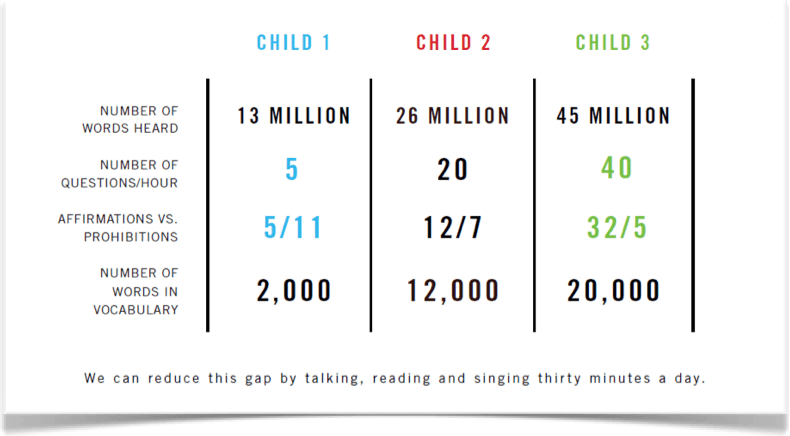
SES differences in language processing skill and vocabulary are evident at 18 months
Speech and Language Developmental Milestones

How to work towards change according to Tandem™ who promotes early literacy and family engagement programming in the Bay Area.

Kids that are exposed to domestic violence

Domestic Violence and Children – Fact Sheet

Behind Closed Doors The Impact of Domestic Violence on Children

Children’s Exposure to Domestic Violence- Academic Research and Resource Guide

30 Shocking Domestic Violence Statistics That Remind Us It’s An Epidemic

Books

Mommy’s Black Eye: Children Dealing With Domestic Violence

Ibby’s Feelings

Migrant Community- fact sheet

Ways to help

Early intervention is one of the best ways to counteract the effects of witnessing abuse. Ways to help children who have witnessed domestic abuse include:

  • Arrange school age children to receive counseling from professionals at their school, often school counselors.
  • Experiment with various types of counseling: play therapy, peer support groups, anger management classes and safety programs to teach kids how to extract themselves from dangerous situations.
  • Help children find a loving and supportive adult to introduce to the child and encourage the child to spend as much time regularly with the adult. This may include a trusted family member or community advocate. Family Violence Defense Fund reports that the single most important ingredient to help children heal and develop resiliency is the presence of a loving adult.
  • Provide a safe environment that does not include violence in any form after a child has witnessed domestic violence.
  • Find ways to discipline that do not involve hitting, name-calling, yelling, or any form of verbally aggressive behavior.
  • Help children create a sense of safety by having scheduled routines, such as regular meals and homework times.

Happy Kids!

Image

Happy kids is what we universally want to see. Check out this info-graphic on what lends to that happiness.

Developing a personal relationship with your innerself

“In the depth of winter; I finally learned that within me there lay an invincible summer”

–Albert Camus

I really like to help develop the concept with students, adults, and myself of self awareness through a process of checking in with ones self. That important swing inward to ask “Where do I stand on this topic?” is an important skill to developing a good relationship with yourself.

“Our greatness lies not so much in being able to remake the world as being able to remake ourselves.” -Gandhi

We can let the circumstances of our lives harden us so that we become increasingly resentful and afraid, or we can let them soften us and make us kinder and more open to what scares us. We always have this choice. ~ Pema Chodron

Building Self-Trust

Maintaining a good relationship with yourself is no different than maintaining a good relationship with a partner, a friend, or a family member. All relationships take time, effort, and good communication. Could it be that you have lost communication with yourself? Poor communication with yourself can lead to the perception that you have abandoned yourself. It can lead to a distorted perception of other relationships in your life.

Developing Self Talk

Self-talk can have a really great impact on your self-esteem and confidence. There is positive and negative self-talk and they both have an impact on how you feel. There are a few ways you can develop better self-talk including just listening to what you’re saying to yourself each day. It’s worth practicing self-talk as feeling good about yourself is worth the effort.

Self-Compassion Guided Meditations and Exercises

Dialectical Behavioral Therapy (DBT) has the concept of Wise Mind which can be a helpful tool in understanding what a inner dialog should touch upon. Finding The Balance in Opposing Forces: Dialectical Behavioral Therapy

Cutting/ Non-Suicidal Self-Injury (NSSI)

Non-suicidal self-injury (NSSI) is defined as deliberately injuring oneself without suicidal intent. The most common form of NSSI is self-cutting, but other forms include burning, scratching, hitting, intentionally preventing wounds from healing, and other similar behaviors. Tattoos and body piercings are not considered NSSI, unless they are created with the specific intention to self-harm. NSSI is often inflicted on the hands, wrists, stomach, or thighs, but it can occur anywhere on the body.

Rates of NSSI are highest among adolescents and young adults. Although estimates vary, approximately 12%-24% of adolescents and young adults have self-injured, and 6%-8% report current, chronic self-injury. Some individuals continue to engage in these behaviors well into adulthood, especially when they do not receive treatment. Source

Risk Factors

  • Knowledge that friends or acquaintances are cutting
  • Difficulty expressing feelings
  • Extreme emotional reactions to minor occurrences (anger or sorrow)
  • Stressful family events (divorce, death, conflict)
  • Loss of a friend, boyfriend/girlfriend, or social status
  • Negative body image
  • Lack of coping skills
  • Depression

Signs

  • Wearing long sleeves during warm weather
  • Wearing thick wristbands that are never removed
  • Unexplained marks on body
  • Secretive or elusive behavior
  • Spending lengthy periods of time alone
  • Items that could be used for cutting (knives, scissors, safety pins, razors) are missing

What should you do?
If you become aware that your child is engaging in self-injurious acts, remember that it is fairly common. Though it is often frightening for parents, the majority of teens who cut themselves do not intend to inflict serious injury or cause death. If the injury appears to pose potential medical risks, contact emergency medical services immediately. If the injury doesn’t appear to pose immediate medical risks, remain calm and nonjudgmental, contact your child’s pediatrician to discuss the concerns, and ask for a referral to a trained mental health professional who has experience in this area. Source

Overview for school staff:

Educators & Self Injury How to recognize, understand, and respond to nonsuicidal self-injury.

Quick reference protocol in steps to intervene at school.  Helps remind staff of steps in intervening with a student who has been cutting.

Parent Notification Form– Please involve parents by informing them by phone prior to sending the form home this parent notification.

Parent Fact Sheet– to go home with Parent Notification Form.

Suicide Risk Assessment Summary Sheet  This is a very good tool.

Safety Contract for Adolescents

Further reading:

Non-Suicidal Self-Injury in Schools: Developing & Implementing School Protocol

PPT Self-Injury Interventions for School Psychologists

Why Teenagers Cut, and How to Help

Need help for self-harm?

If you’re not sure where to turn, call the S.A.F.E. Alternatives information line in the U.S. at (800) 366-8288 for referrals and support for cutting and self-harm. For helplines in other countries, see Resources and References below.

In the middle of a crisis?

If you’re feeling suicidal and need help right now, call the National Suicide Prevention Lifeline in the U.S. at (800) 273-8255. For a suicide helpline outside the U.S., visit Befrienders Worldwide.

Data collection in schools for behavioral intervention 

  
Schools are built to handle a wide span of behaviors that students express while in school. For those students that need more support the learning professionals go find deeper understanding through data collection. As dry of a subject as that might be, it gets more interesting as you learn more about what works and see students succeed. 

A friend of mine passed along a great resource with a lot data collection tools. Data collection tools.

Here is another resource: PENT BIP Manual

A blurb from Behavior Advisor:

Behavior assessment is based upon the following assumptions:

-challenging behaviors do not occur in a vacuum; there is a reason for their occurrence

-behaviors occur in response to an identifiable stimuli (event)

-behaviors are governed (weakened or strengthened) by the consequences that follow them

-behavior is a form of communication (i.e., educators need to figure out what a particular behavior is communicating. The displayed action might be saying, in a non-verbal fashion; “I am tired.”, “I am bored.”, “I’m still upset at what happened earlier”, etc.)
-“misbehavior” might actually be adaptive (justifiable and understandable) given the circumstances. For example, in a classroom in which the teacher is a ineffective manager of student behavior, the student of concern might engage in “inappropriate” actions designed to bond with, and offer protection from bullies.

In this particular case, the “misbehavior” could be designed toavoid victimization  by other students in the presence of the non-protective teacher.

It is believed that all behaviors demonstrated by all persons serve a function and have a purpose. If benefits didn’t result from showing certain behavior, then individuals would stop doing them. Usually, our behaviors are meant to do one of two things:

-obtain something desirable (e.g., attention, money, good grades), or

-avoid or escape something unpleasant or punishing (e.g., penalties, embarrassment, pain, fear)

Epilepsy in school children

Educator overview video:

Seizure First Aid video:

At School

Most children with epilepsy attend school and can participate in all activities. Some may need to take medicine at school, help with certain subjects, or extra time on tests. They may sometimes have seizures at school. With more than 300,000 school-age children who have epilepsy in the United States, none of this is that unusual. Yet there’s a good chance that many of your child’s teachers and classmates won’t know much about epilepsy. Educating them is one of the most important things you can do to help your child at school.

Teach Your School About Epilepsy and Seizures

Start each school year by scheduling a meeting with your child’s teacher. Discuss your child’s condition, any learning issues and how to respond if your child has a seizure. Ask if there are others at the school you should talk to or give information to, such as gym teachers, school nurses, the librarian, etc. Keep in touch with them through the school year about your child’s progress, changes in medication and any related issues.

Ask your teacher to discuss epilepsy with the class in a way that is appropriate for the age level and that would be comfortable for your child. Having a seizure at school can be embarrassing for a child and frightening for others. It is better if the teacher discussed it with the students beforehand. Talking to students about epilepsy can help prevent teasing and correct some of the inaccuracies children may have heard. Offer to provide books and other materials the teacher can use. Review the Get Involved section of this website for ideas.

Make sure that all adults who supervise your child during the school day know what to do if your child has a seizure. Don’t forget about school bus drivers, lunchroom supervisors, student teachers, etc. Ask officials to post “seizure management” first aid tips in visible locations around the school.

Source

Articles

ACCOMMODATING STUDENTS WITH EPILEPSY OR SEIZURE DISORDERS: EFFECTIVE STRATEGIES FOR TEACHERS

Book

Good Forms For Schools

MY SEIZURE PLAN

Seizure Action Plan

Questionaires to help parents and schools address the needs of and provide a supportive learning environment for a child with seizures

Exploring feelings with your kids

https://youtu.be/hAckcoesj4s

Activities:

20 minute fun activities for parents and children that promote resilience by encouraging flexible thinking.

Emotional Intelligence Activities for Kids

Navigating Your Child’s Emotional Ups and Downs

Video:

Amygdala Hijack & Emotional Intelligence

How can we build flexibility into every day parenting?

  • Involve children in making decisions when possible.
  • Inventory the current needs to make a decision based on the present moment.
  • don’t get stuck on musts and should’s if something is not working don’t be afraid to change it.
  • Trust children to do things for themselves, even if it doesn’t turn out perfectly or quite how you wished it would.
  • Have routines for predictability not as a means to reward, punish or control.
  • Plan on extra time whenever possible so that special moments don’t have to be lost or abandoned all the time.
  • Ask questions and welcome cooperation instead of making demands.
  • Take time to care for yourself – you can only give as much love and care to others as you have for yourself! (That’s the elastic thing again – when we give too much we SNAP!)
  • Accept your child’s feelings as authentic expression, not something you must control or squash.
  • Dare to do things differently, be ridiculous and cultivate laughter – this will help you relax and let go!
  • Say YES when you can and say NO with kindness.

Source

Communication:

Improving Family Communications

Parent/Child Communication

Just around the corner is National School Psychologist Awareness Week 2015!

National School Psychologist Awareness Week 2015 will be celebrated from November 9-13, 2015, to focus public attention on the important role of school psychologists in promoting school and life success for students.  School psychologists work with students and teachers every day to promote wellness and resilience, reinforce communication and social skills, and increase achievement academically, socially, behaviorally, and emotionally.

Political commentary video on recent comments made by Jeb Bush.

Click to access 2015-SPAW-Poster.pdf

Teaching Internet Safety

The internet, cell phones, and modern communication technology is a new area of learning for us parents. Especially, as it applies to our kids and their use of it communicating with others. What is your stance on monitoring, educating, and setting boundaries with these technologies in your family?

A great resource that I have use as a tool to help filter and understand this topic of teaching technology safety has been Common Sense Media.

Common Sense is dedicated to helping kids thrive in a world of media and technology.  We empower parents, teachers, and policymakers by providing unbiased information, trusted advice, and innovative tools to help them harness the power of media and technology as a positive force in all kids’ lives.

The Parent  Concern page on Common Sense Media really helped me understand how to get to answers for our family. Similarly the Advice page is informative as well.

For educators they offer a Digital Citizenship curriculum for K-12. Also content in Spanish.

Cell Phone Video

Set some ground rules with a Family Media contract.

Teen/ Tween Quiz and Games to educate on Digital literacy, Inappropriate content, Online privacy, Online predators, Cyberbullying. Estimated running time: 20 minutes.

Digital Compass is the only educational game that gives kids the freedom to explore how decisions made in their digital lives can impact their relationships and future.

Articles

Super Duper Article-Teaching Children Internet Safety by Becky L. Spivey, M.Ed

Technology is not ruining our kids. Parents (and their technology) are ruining them

CDC Tips