Creativity and the brain

I have to share that when I walk my kids in the stroller on the weekend, I habitually listen to Krista Tippet interviewer extraordinaire. She picks topics that keep my head swimming in possibilities. This week she interviewed Rex Jung on Creativity. I think that this is really relevant for educators and especially School Psychologist who are constantly having to measure children’s potential in a variety of areas.

*One thing I did not like during the interview was the use of the word “Retarded”. I think that they should have been savvy enough to use the more modern, respectful, accurate descriptor of “Intellectual Disability”. UPDATE: I emailed Rex Jung about this terminology and he promptly responded, saying he wishes that we could do away with all labels. I agree with him and think he has his heart in the right place when it comes to people in general.

Click here: Rex Jung — Creativity and the Everyday Brain | On Being onbeing.org Few features of humanity are more fascinating than creativity; and few fields are more dynamic now than neuroscience. Rex Jung is working on a cutting edge of science, exploring the differences and interplay between intelligence and creativity

is an Assistant Professor of Neurosurgery at the University of New Mexico in Albuquerque. He’s a Distinguished Senior Advisor to the Positive Neuroscience Project, based at the University of Pennsylvania.

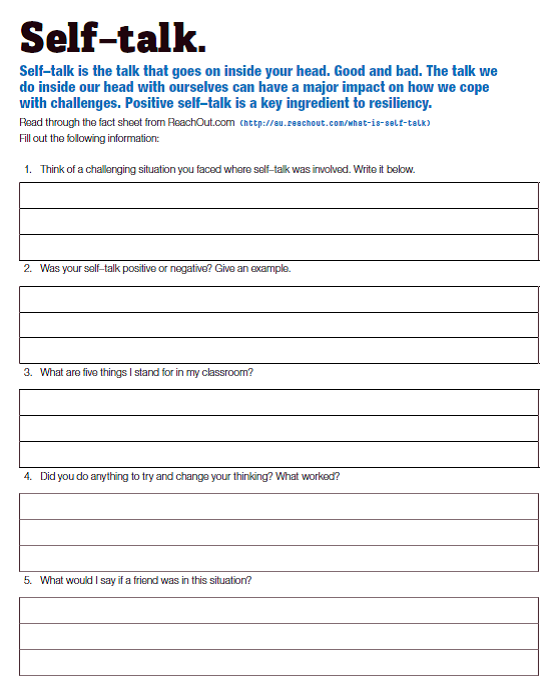
Your thoughts are important when learning

Negative self talk can plague a student’s success in the classroom.

Worksheet: here

Five Key Points

In What Students Say to Themselves: Internal Dialogue and School Success (Thousand Oaks, CA: Corwin Press, 2000), William Watson Purkey suggests the following five points to keep in mind as you try to shape students’ self-talk:

  1. What significant people think about students and how they act toward students influences how students define themselves.
  2. How students define themselves in their internal dialogue influences their academic success and failure.
  3. Everything the school does and the way things are done influences what students say to themselves.
  4. Altering how students define themselves involves altering the total school environment.
  5. The task of the school is to structure experiences that reduce crippling self-talk while inviting students to define themselves in essentially positive and realistic ways. (p. 77)

Source

Teacher Notes here

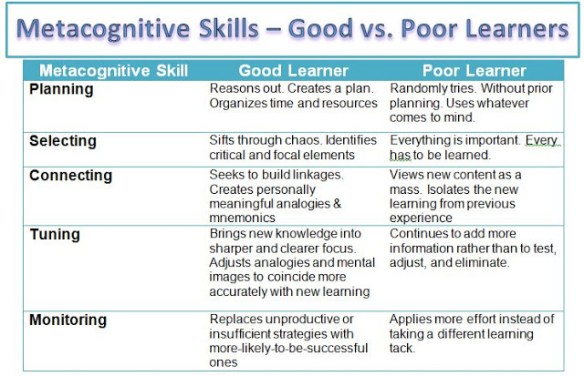
One path to get to better academic thought is through meta-cognitive strategies.

Metacognition is one’s ability to use prior knowledge to plan a strategy for approaching a learning task, take necessary steps to problem solve, reflect on and evaluate results, and modify one’s approach as needed. It helps learners choose the right cognitive tool for the task and plays a critical role in successful learning.

Fogarty (1994) suggests that metacognition is a process that spans three distinct phases, and that, to be successful thinkers, students must do the following:

  1. Develop a plan before approaching a learning task, such as reading for comprehension or solving a math problem.
  2.  Monitor their understanding; use “fix-up” strategies when meaning breaks down.
  3.  Evaluate their thinking after completing the task.

So when we look at eliciting meta-cognition we really are trying to amplify curiosity. While giving a nod to scientific thought and inquiry as a way to try and fail, while being more accepting of our learning because we see the the failure as part of the evaluative process of learning.

Deeper reading: here and here

Family Routine Guide for 2-5 year olds

I was just talking to a parent about establishing routines in the evening hours with her toddler and remembered the “Family Routine Guide”. It is a wonderfully pragmatic tool to look up great interventions for common issues that come up for families with toddlers.

This Family Routine Guide was developed by Rochelle Lentini and Lise Fox to assist parents and caregivers in developing a plan to support young children who are using challenging behavior. Children engage in challenging behavior for a variety of reasons, but all children use challenging behavior to communicate messages. Challenging behavior, typically, communicates a need to escape or avoid a person/activity or communicates a desire to obtain someone/something. Once parents understand the purpose or meaning of the behavior, they can begin to select strategies to change the behavior. They can do this by selecting prevention strategies, teaching new skills, and changing the way they respond in an effort to eliminate or minimize the challenging behavior.

Family Routine Guide English

Guía de rutinas familiares (Spanish version)

Pediatric Autoimmune Neuropsychiatric Disorders Associated with Streptococcal Infection (PANDAS) and Pediatric Acute-Onset Neuropsychiatric Syndrome (PANS)

Recently, learned about PANS / PANDAS at one of my schools and wanted to pass on the information that I learned about it in supporting students with the Disorder.

A diagnosis of PANDAS or PANS means a child has a sudden, dramatic change in personality displayed as Obsessive Compulsive Disorder (OCD) together with accompanying symptoms following a strep, bacterial, or viral infection. The OCD can display as intense fear or anxiety. Accompanying symptoms may include tics, anxiety, depression, behavioral regression, deterioration in school performance, sensory sensitivities, severely restricted food intake, and more;

Families Experience link: here

Teacher link: here

School Psychologist link: here

Occupational Therapist link: here

School Considerations link: here

PANS/ PANDAS PowerPoint: here

Resources:

PANDAS Network

Information for parents, educators, and the medical community including: diagnosis, testing, treatment, current research, providers, education tools, legislative updates and more.

PANDAS Physicians Network

PPN is dedicated to helping medical professionals better understand PANDAS and PANS through real-time information and networking. Specialists from the top academic medical institutions in the United States who have worked with, treated, or studied the patients or aspects of the disorder, have agreed to serve on PPN committees or as special advisors. Because PANDAS & PANS are interdisciplinary disorders, all the relevant disciplines are represented on the PPN committees and the special advisory council.

Stanford University’s PANS clinic

Helping out with your child’s homework

Homework can be a daunting task for both kids and parents. It sounds pretty straight forward but ends up looking like the graphic below.

Tips:

  1. Stay connected to your child’s teacher(s).
  2. Keep a regular homework time. Ensure the work space is conducive to study.
  3. Do a similar task (read, balance checkbook) in close proximity to your student to be available for questions and encouragement.
  4. Stay positive!

Worksheet: Work out study environment issues.

Contract: Homework Planning Sheet 

Resources:

Homework: A Guide for Parents

Here are two Free learning resources.

Learn Zillion offers a free and growing set of Math and English Language videos and practice problems for grades 2-12 that have been developed by expert teachers directly from the Common Core State Standards.

Khan Academy

Khan Academy empowers coaches of all kinds to better understand what their children or students are up to and how best to help them.

Screen Time

Many of us with kids are losing the battle with screen time. Whether it is the TV, Tablet, Phone, or Laptop there is a constant pressure that families have to negotiate through with their kids.

Dr. Victoria Dunckley suggest that there maybe a new issue attached to too much screen time called Electronic Screen Syndrome. Here is her description of what she sees in children with this issue.

https://youtu.be/u4dmUJEHw9M

Article on Electronic Screen Syndrome

Brain researchers have found a few the following detrimental effects:

Great Article

Check your stress!

As we all know stress can be really bad for your mental and physical health. Take a moment and reflect on where you fall on the chart below to measure your levels.

The Holmes and Rahe Stress Scale

Be good to yourself and practice good self care.

Here is an inventory to check to see how you are doing with your self care.

Self Care Inventory

Also here is a Coping Checklist so you can see positive and negative ways that you Cognitively, Behaviorally, and Emotionally and Socially deal with stress.

Coping Worksheet

Go further and log your progress for a week  (See Below).

Empathy

 Empathy is a 21st century skill that our kids will need more and more of in order to make the most of their future. A lot of smart organizations, schools, and businesses are cultivating this skill set in their people. It helps people not only connect, but get to the deeper detailed aspects of issues. That empathetic connection gets to better outcomes.

Brené Brown on Empathy

A father told me a story the other day about how he was driving down the road with his son in the car and was cut off by another driver. He yelled out, “Hey Buddy watch your driving!” His son then said, “Dad what if they are just learning how to drive? Take it easy.” The Dad now with this new possibility found himself calm and move on from feeling angry.

My point is that we all deal with adversity, but how we filter that information can dramatically change your reaction. This boy showed his dad that showing empathy by considering the possibility that the driver who cut his dad off could be learning how to drive and be given some leeway. Seeing possibilities is liberating, try it!

Just a last thought about how to support empathy with your special little person. Some children at school who have a hard time working through social situations often time need social skills training. Here is a great worksheet to help with breaking down a social situation to make good decisions and more importantly a teachable moment for a student.

Click to access social-problem-solving-template.pdf

Dr. Ellen Langer on Mindfullness and Mindlessness

So, as you may or may not know I am addicted to Krista Tippitt’s podcast On Being. She recently interviewed Dr. Ellen Langer on Mindfulness and Mindlessness. I was expecting something deeply connected to Buddhism with some science. This was not the case. Come to find out that for 35 or so years Dr. Langer has dedicated most of her studies toward Mindfuless and Mindlessness experiments.

The key features of what I liked about this very worthy subject is that language and perspective can largely effect us and the outcomes we seek. She proves through science that if we think in terms that reflect the positive nature of the actions we take, many of negative side effects tend to disappear. She suggests that if we allow ourselves to notice new aspects of people or topics it helps to keep our world fresh and open to possibilities, which in turn keeps our brains more in-tune and happy for lack of a better explanation.

Podcast: 

Here is a video that is equally as engaging as the podcast:

Bullying and Special Needs Students

Middle Schools can be a tough place to navigate socially for all children. For children who have cognitive and social deficits it can be especially difficult. Recently while looking into different options to help support kids on our campus, I ran across the Ohio Center For Autism and Low Incidence (OCALI) website. On the site it has a multitude of resources including some on the topic of Bullying. They have an easy to implement anti-bullying intervention called “Be an Upstander”.

Anti-Bullying Supports for Peers: Be An Upstander
Be an Upstander is a video for use with middle- and high-school students. It demonstrates strategies that can turn bystanders (persons not directly involved in the bullying incident) into Upstanders, those who can help diffuse a bullying situation. Resources to help facilitators use this video include a Facilitator Guide and Strategy List.

Webcast and Resource Materials on Bullying

Awesome Brochure

Stats from the Autism Safety Site:

A 2009 survey on bullying revealed the following:

  • 65% of parents reported that their children with Asperger’s syndrome had been victimized by peers in some way within the past year
  • 47% reported that their children had been hit by peers or siblings
  • 50% reported them to be scared by their peers
  • 9% were attacked by a gang and hurt in the private parts
  • 12% indicated their child had never been invited to a birthday party
  • 6% were almost always picked last for teams
  • 3% ate alone at lunch every day

Source: Issues in Comprehensive Pediatric Nursing (2009)