Check in Check Out (CICO) a tool to help set expectations and improve classroom behavior

Students can be motivated to improve classroom behaviors if they have both a clear road-map of the teacher’s behavioral expectations and incentives to work toward those behavioral goals.  This modified version of Check-In/Check-Out (CI/CO) is a simple behavioral intervention package designed for use during a single 30- to 90-minute classroom period (Dart, Cook, Collins, Gresham & Chenier, 2012). The teacher checks in with the student to set behavioral goals at the start of the period, then checks out with the student at the close of the period to rate that student’s conduct and award points or other incentives earned for attaining behavioral goal(s).

First Step: Make a behavior report card for your student needing extra TLC.

Generic Behavior Report Card

Custom Behavior Report Card

Procedure. During any class session or other evaluation period when CI/CO is in effect, the teacher follows these 3 steps:

  1. Check-In. At the start of the class session, the teacher meets briefly with the student to review the behavioral goals on the Behavior Report Card and to provide encouragement. The teacher also prompts the student to set a behavioral goal on at least one of the target behaviors (e.g., “Today I will not leave my seat once without permission.”).

  2. Monitoring/Evaluation. During the session, the teacher observes the student’s behaviors. At the end of the session, the teacher rates the student’s behaviors on the Behavior Report Card.

  3. Check-Out. At the end of the class session, the teacher again meets briefly with the student. The student reports out on whether he or she was able to attain the behavioral goal(s) discussed at check-in. The teacher then shares the BRC ratings. If the student has earned a reward/incentive, the teacher awards that reward and praises the student. If the student fails to earn the reward, the teacher provides encouragement about success in a future session.

Materials: How To: Manage Problem Behaviors: Check-In/Check-Out

Homework how much should my child be doing at night?

Homework usually falls into one of three categories: practice, preparation, or extension. The purpose usually varies by grade. Individualized assignments that tap into students’ existing skills or interests can be motivating. At the elementary school level, homework can help students develop study skills and habits and can keep families informed about their child’s learning. At the secondary school level, student homework is associated with greater academic achievement. (Review of Educational Research, 2006)

How Much Homework Per Day is Optimal? What the Research Says…
Grade Source 1
(Barkley, 2008)
Source 2
(Cooper, Robinson, & Patall, 2006)
Source 3
(Olympia & Andrews,1994)
1 10 Minutes 10-45 Minutes
2 20 Minutes 10-45 Minutes
3 30 Minutes  — 10-45 Minutes
4 40 Minutes  — 45-90 Minutes
5 50 Minutes 45-90 Minutes
6 1 Hour 45-90 Minutes
7 1 Hour 10 Minutes 1-2 Hours 1-2 Hours
8 1 Hour 20 Minutes 1-2 Hours 1-2 Hours
9 1 Hour 30 Minutes 1.5-2.5 Hours 1-2 Hours
10 1 Hour 40 Minutes 1.5-2.5 Hours 1.5-2.5 Hours
11 1 Hour 50 Minutes 1.5-2.5 Hours 1.5-2.5 Hours
12  2 Hours  1.5-2.5 Hours 1.5-2.5 Hours

Chart: Source

I am a big proponent of reading everyday.

image8108966346613792902

Parents: Helping Your Child with Homework

Educators: Got Homework? An ACSA Policy Position Paper on Homework

Role Modeling for Resilience

Kids do what we model for them. This commercial is an extreme representation of bad role modeling called “Children See. Children Do.” It does represent how our behavior as adults model behavior for our children. (VIDEO is not for the squeamish).

https://youtu.be/5JrtpCM4yMM

What is resilience?

Resilience is a dynamic process wherein individuals display positive adaptation despite experiences of significant adversity or trauma. This term does not represent a personality trait or an attribute of the individual (Luthar et al., 2000; Masten, 1999; Rutter, 1999, 2000). Rather, it is a two-dimensional construct that implies exposure to adversity and the manifestation of positive adjustment outcomes. Source

Life can be challenging and may include many stressful situations. Parents and children can feel overwhelmed by different things at different times like:

Stressful situations

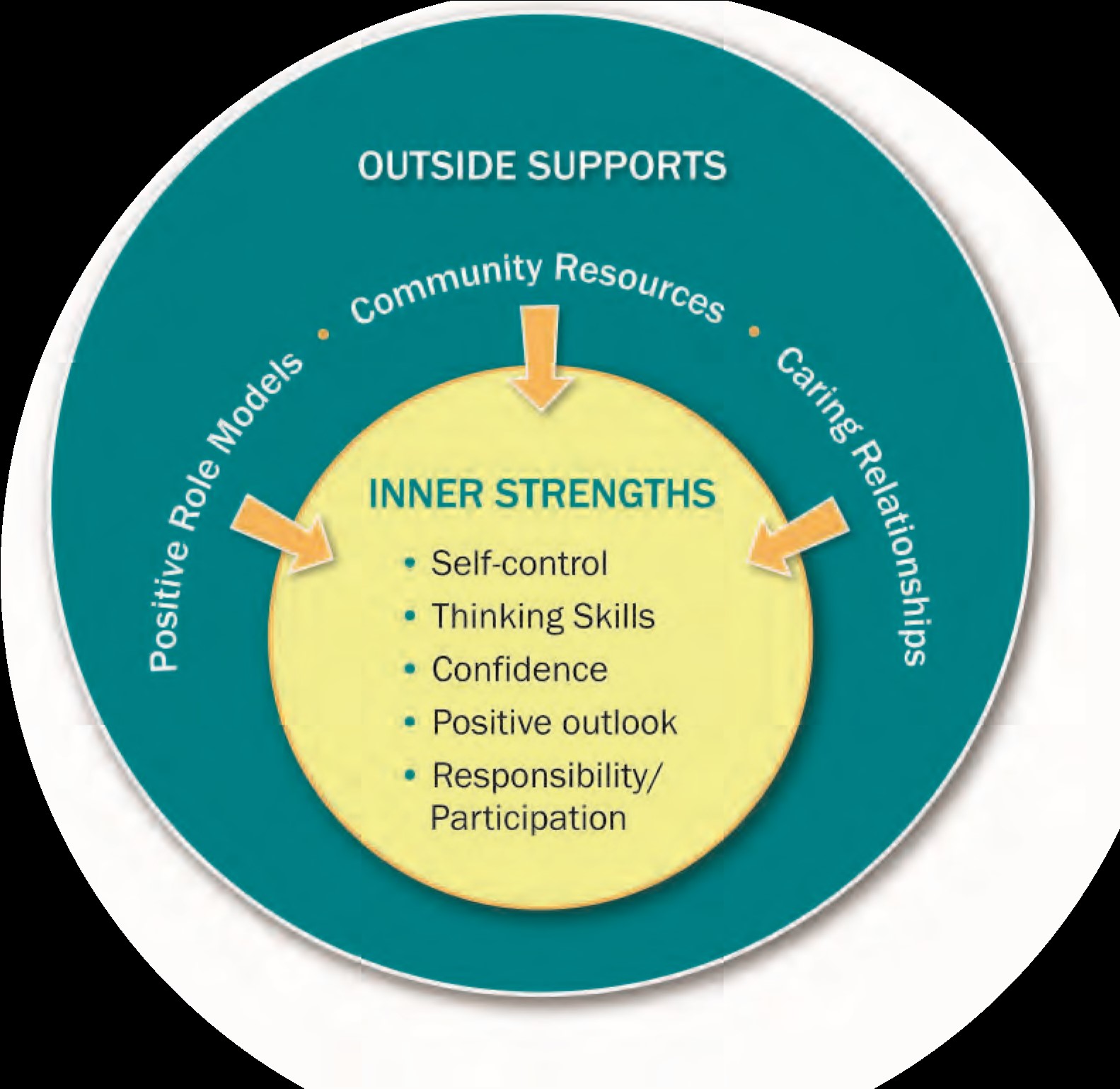
In times of need kids may need outside and inside supports:

inside and outside supports

Focus on developing multiple facets of developing a child’s sense of self in the world.

Take-The Resiliency Quiz

Cool concept: The Resiliency Doughnut

Great article on resiliency: Hard-Wired to Bounce Back- By Nan Henderson

Resources for Parents

Parenting Resilient Children at Home and at School

—www.raisingresilientkids.com

—www.dosomething.org

40 Developmental Assets for Adolescents – —www.search-institute.org

10 phrases you hear in resilient families: are you using them?

Explanatory style—thinking habits that affect our resilience

Great PowerPoint: Raising Resilient Children

Hopeful TED talk.

Talk for Educators:

Reflective reads for educators (Authenticity)

Reflective practices and teaching go hand in hand. Teachers/ educators are very aware of their strengths and areas to improve. Kids tend to help us realize these areas in real time as we work through our day. The best strategy oftentimes is to address, adjust and move on. In that spirit, I have collected a few articles to read.

The following Carl Rogers quote is for my counseling and school psychologist colleagues.

Can I be strong enough as a person to be separate from the other? Can I be a sturdy respecter of my own feelings, my own needs, as well as his? Can I own and, if need be, express my own feelings as something belonging to me and separate from his feelings? Am I strong enough in my own separateness that I will not be downcast by his depression, frightened by his fear, nor engulfed by his dependency? Is my inner self hardy enough to realise that I am not destroyed by his anger, taken over by his need for dependence, nor enslaved by his love, but that I exist separate from him with feelings and rights of my own? When I can freely feel this strength of being a separate person, then I find that I can let myself go much more deeply in understanding and accepting him because I am not fearful of losing myself. (1961, p.52.)

Rogers, C. R. (1961), On Becoming a Person. Boston: Houghton Mifflin.

Teaching

  1. Authenticity in teaching
  2. Teaching with authenticity 
  3. Higher education article
  4. Perception of authenticity

General boundaries

  1. 8 preventers of authentic happiness
  2. Book suggestion

A big player in psychology is Martin Seligman who wrote  Authentic Happiness (2002) which brought positive psychology into the mainstream.

In Authentic Happiness, Seligman describes a compellingly simple model of happiness based on three pathways:

Positive emotion – leading to a pleasant life

Flow – leading to an engaged life

Purpose – leading to a meaningful life

In short, the Authentic Happiness model suggested that you can achieve happiness in your life by pursuing one or more of these three pathways. This means that even if, for example, you don’t experience much positive emotion in your life, you can still be happy by doing activities which engage or absorb you fully, or by finding meaning in life by using your strengths in service of something larger. This conclusion was probably quite a relief to Seligman, who freely acknowledges in the book that until relatively recently he himself had been a bit of a grouch.

Comics and Reading

Obviously from the name of my blog I am a proponent in building momentum towards positive outcomes for kids. When I was learning to read in elementary school it was laborious and boring at first. Then as time went on I discovered the Tin Tin Series of comics and have loved reading ever since.

When I sit in meetings talking about certain students who struggle with their reading I often ask if they have books that are for fun and leisure around to practice with at home for down time. Quite often the answer is kinda. So, I think it is a worthy pursuit to find those interesting books, comics, and magazines to build that inertia of reading practice.

Articles:

How Comics Helped My Kid Love Reading

10 Great Kids Comics for Early Readers

Graphic Language: How to Read Comic Books with Your Kid

How Comics & Graphic Novels Can Help Your Kids Love To Read!

For Improving Early Literacy, Reading Comics Is No Child’s Play

Using comics to improve your child’s literacy

How comic books can help improve literacy

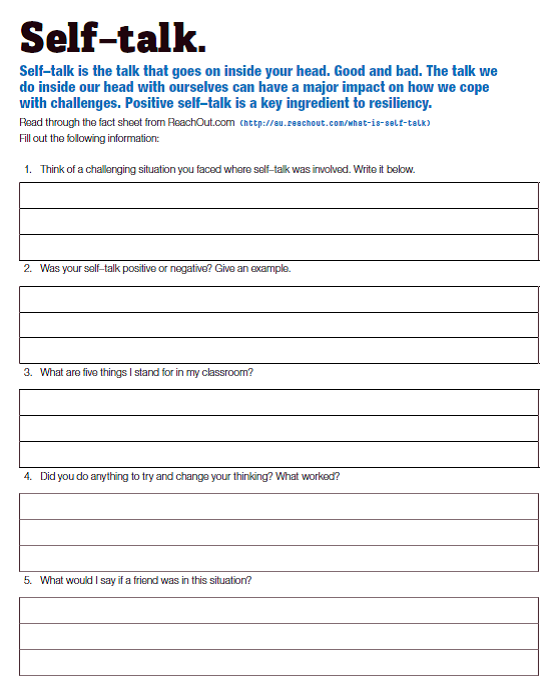
Your thoughts are important when learning

Negative self talk can plague a student’s success in the classroom.

Worksheet: here

Five Key Points

In What Students Say to Themselves: Internal Dialogue and School Success (Thousand Oaks, CA: Corwin Press, 2000), William Watson Purkey suggests the following five points to keep in mind as you try to shape students’ self-talk:

  1. What significant people think about students and how they act toward students influences how students define themselves.
  2. How students define themselves in their internal dialogue influences their academic success and failure.
  3. Everything the school does and the way things are done influences what students say to themselves.
  4. Altering how students define themselves involves altering the total school environment.
  5. The task of the school is to structure experiences that reduce crippling self-talk while inviting students to define themselves in essentially positive and realistic ways. (p. 77)

Source

Teacher Notes here

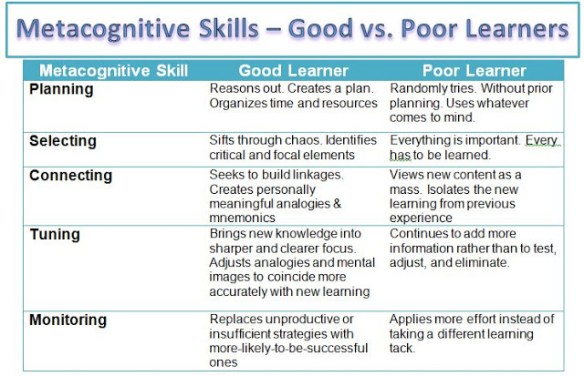
One path to get to better academic thought is through meta-cognitive strategies.

Metacognition is one’s ability to use prior knowledge to plan a strategy for approaching a learning task, take necessary steps to problem solve, reflect on and evaluate results, and modify one’s approach as needed. It helps learners choose the right cognitive tool for the task and plays a critical role in successful learning.

Fogarty (1994) suggests that metacognition is a process that spans three distinct phases, and that, to be successful thinkers, students must do the following:

  1. Develop a plan before approaching a learning task, such as reading for comprehension or solving a math problem.
  2.  Monitor their understanding; use “fix-up” strategies when meaning breaks down.
  3.  Evaluate their thinking after completing the task.

So when we look at eliciting meta-cognition we really are trying to amplify curiosity. While giving a nod to scientific thought and inquiry as a way to try and fail, while being more accepting of our learning because we see the the failure as part of the evaluative process of learning.

Deeper reading: here and here