How can we build flexibility into every day parenting?
Involve children in making decisions when possible.
Inventory the current needs to make a decision based on the present moment.
don’t get stuck on musts and should’s if something is not working don’t be afraid to change it.
Trust children to do things for themselves, even if it doesn’t turn out perfectly or quite how you wished it would.
Have routines for predictability not as a means to reward, punish or control.
Plan on extra time whenever possible so that special moments don’t have to be lost or abandoned all the time.
Ask questions and welcome cooperation instead of making demands.
Take time to care for yourself – you can only give as much love and care to others as you have for yourself! (That’s the elastic thing again – when we give too much we SNAP!)
Accept your child’s feelings as authentic expression, not something you must control or squash.
Dare to do things differently, be ridiculous and cultivate laughter – this will help you relax and let go!
Suicide is a major public health concern. Over 41,000 people die by suicide each year in the United States. More than twice as many people die by suicide each year than by homicide . Suicide is tragic. But it is often preventable. Knowing the risk factors for suicide and who is at risk can help reduce the suicide rate.
Who is at risk for suicide?
Suicide does not discriminate. People of all genders, ages, and ethnicities can be at risk for suicide. But people most at risk tend to share certain characteristics. The main risk factors for suicide are:
Depression, other mental disorders, or substance abuse disorder
A prior suicide attempt
Family history of a mental disorder or substance abuse
Family history of suicide
Family violence, including physical or sexual abuse
Having guns or other firearms in the home
Incarceration, being in prison or jail
Being exposed to others’ suicidal behavior, such as that of family members, peers, or media figures.
The risk for suicidal behavior is complex. Research suggests that people who attempt suicide differ from others in many aspects of how they think, react to events, and make decisions. There are differences in aspects of memory, attention, planning, and emotion, for example. These differences often occur along with disorders like depression, substance use, anxiety, and psychosis. Sometimes suicidal behavior is triggered by events such as personal loss or violence.
In order to be able to detect those at risk and prevent suicide, it is crucial that we understand the role of both long-term factors—such as experiences in childhood—and more immediate factors like mental health and recent life events. Researchers are also looking at how genes can either increase risk or make someone more resilient to loss and hardships.
Many people have some of these risk factors but do not attempt suicide. Suicide is not a normal response to stress. It is however, a sign of extreme distress, not a harmless bid for attention.
Jane Pearson on Warning Signs for Childhood Suicide
It’s a question asked by parents, educators and health professionals. How do we prevent suicide among our children? In this special podcast series devoted to Children’s Mental Health Awareness Day, Dr. Jane Pearson of the National Institute of Mental Health talks about important warning signs that come from children. She also looks at how well-intended reaction to tragedy can have unintended consequences. Dr. Pearson is with the Division of Services and Intervention Research at NIMH and a leading expert on suicide research.
Call the toll-free National Suicide Prevention Lifeline at 1-800-273-TALK (8255), available 24 hours a day, 7 days a week. The service is available to anyone. All calls are confidential.http://www.suicidepreventionlifeline.org
Bullying is characterized by aggression used within a relationship where the aggressor(s) has more real or perceived power than the target, and the aggression is repeated, or has the potential to be repeated, over time. Bullying can involve overt physical behavior or verbal, emotional, or social behaviors (e.g., excluding someone from social activities, making threats, withdrawing attention, destroying someone’s reputation) and can range from blatant aggression to far more subtle and covert behaviors. Cyberbullying, or bullying through electronic technology (e.g., cell phones, computers, online/social media), can include offensive text messages or e-mails, rumors or embarrassing photos posted on social networking sites, or fake online profiles.
Source: Dear Colleague Letter: MS Word (91KB) | PDF (1.4MB)
Kids do what we model for them. This commercial is an extreme representation of bad role modeling called “Children See. Children Do.” It does represent how our behavior as adults model behavior for our children. (VIDEO is not for the squeamish).
What is resilience?
Resilience is a dynamic process wherein individuals display positive adaptation despite experiences of significant adversity or trauma. This term does not represent a personality trait or an attribute of the individual (Luthar et al., 2000; Masten, 1999; Rutter, 1999, 2000). Rather, it is a two-dimensional construct that implies exposure to adversity and the manifestation of positive adjustment outcomes. Source
Life can be challenging and may include many stressful situations. Parents and children can feel overwhelmed by different things at different times like:
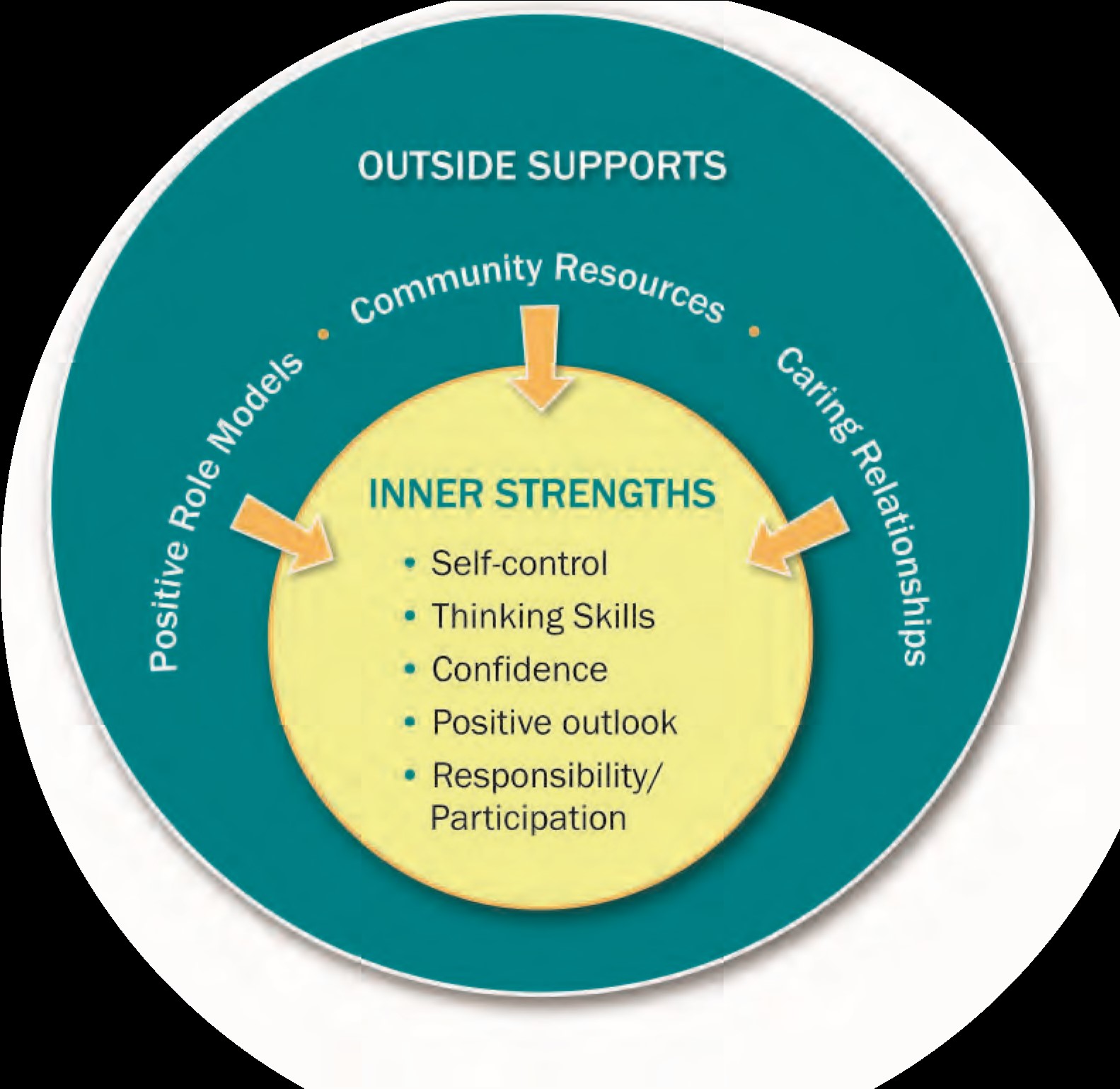
In times of need kids may need outside and inside supports:
Focus on developing multiple facets of developing a child’s sense of self in the world.
Wanting to be a good father, I try to keep my awareness about my kids’ feelings in the forefront of my thoughts. My son had a tantrum the other day and we started talking about how he felt to work through why he was upset. Afterward I started thinking about different experiences I had growing up with feelings. How I might have benefited more from a better coping skills in difficult situations with a more indepth understanding of feelings and what to do when adversity strikes.
Santa Cruz County Office of Education just sent this to me and I think it is a very good resource for receiving and supporting kids that have experienced trauma.
Trauma-Informed Classrooms: What Can Teachers Do?
Here are some classic symptoms of exposure to trauma, and it is safe to assume if a student is in foster care trauma occurred.
Impulsivity—–Memory and focus issues—–Hypersensitivity to stimulation—–Emotional reactivity
Along with referring children to the appropriate school and community resources, such as counseling, social services, etc., there are many things teachers can do to assist these students in the classroom, such as:
Learn about the effects of trauma so that you can spot trauma symptoms when you see them.Understand that a trauma trigger—something that reminds the child of a traumatic event—may send that child into a fight, flight, or freeze response (aggression, running away, or withdrawing). When a child seems to be having a difficult time, ask, “What’s happening for this child? ” rather than “What is wrong with this child?” This simple mental switch may help you realize that the child has been triggered into a fear response.
Make a meaningful connection with the child. Children heal in the presence of relationship. An important part of working with students with trauma history is just showing up and being there no matter what.
Focus on children’s positive behaviors and efforts, and offer specific praise whenever you can. Connect before you redirect. What you focus on, you will get more of.
Provide structure and predictability– As much as possible, maintain a predictable routine and schedule. Write the day’s agenda on the board and structure transition times. Give a heads-up before loud noises like a fire drill or lights going out for a video.
Understand that children who have experienced trauma may be younger developmentally than they are chronologically. (While you wouldn’t be surprised by a tantrum from a 3-year old, you might be surprised by that same behavior in an eight year-old. But developmentally, this eight year-old might be more like three.) It may help to think younger.
Find out what the child needs to feel safe, both physically and emotionally. This might be:
A special place they can go when they’re feeling overwhelmed (for example, a peace corner in the classroom)
A signal you develop with the child to let you know when they’re feeling overwhelmed
A technique that you teach them for self-calming
Create opportunities for children to make choices. This helps them develop a sense of control and overcome the chronic feelings of powerlessness that can result from experiencing trauma and violence.
Model, teach, and practice self-regulation with children. Breathing techniques, stretching or other moving exercises, and sensory calming tools (such as silly putty, stress balls, chew tips for pencils) can help children learn to calm themselves.
Help children cultivate their strengths and interests in both academic and nonacademic arenas (such as martial arts, drama, athletics, music) to help them cultivate a sense of self-confidence and mastery.
Respect the child’s confidentiality. Share information about the child’s status only with appropriate people and only when necessary. And always remember your role as a mandated reporter.
Center on the Developing Child, Harvard University, INBRIEF: Executive Function: Skills for Life and Learning. Plus other resources available at developingchild.harvard.edu
Center on the Developing Child, Harvard University, INBRIEF: The Science of Early Childhood Development.
Child Safety Commissioner, State of Victoria, 2007. Calmer classrooms: A guide to working with traumatised children. ocsc.vic.gov.au
Child Trauma Academy, Surviving Childhood: An Introduction to the Impact of Childhood Trauma, childtraumaacademy.com. Plus other resources available at this website and www.childtrauma.org.
Massachusetts Advocates for Children (2005) Helping Traumatized Children Learn.
National Child Traumatic Stress Network, Trauma Facts for Educators, 2008. Nctsn.org
National Child Traumatic Stress Network, Psychological and Behavioral Impact of Trauma: Elementary School Students, 2008. (Also preschool, middle school, high school versions).
National Scientific Council on the Developing Child (2005). Persistent Fear and Anxiety Can Affect Young Children’s Learning and Development: Working Paper #9. http://www.developingchild.net
Working with children who have experienced trauma can be difficult. It may bring up frustrations, grief and loss issues, fears, and other strong emotions, or it may trigger a teacher’s own trauma issues. Getting help and support around the challenges of working in the classroom is important for anyone who works with children who have experienced trauma.
Lastly, Trauma can be defined as both “Capital T Trauma” and” lower case t trauma” (complex and/or developmental trauma). Big T Trauma usually means large, and sometimes, singular life threatening events or witnessing extreme circumstances; Often the type of event associated with traditional PTSD. Small t trauma can be an accumulation of experience over long periods of time in distressful or neglectful contexts or family systems (read poverty, lack ofan adequate care-giver, emotionally abusive environment, etc.). Either type of childhood experiences can lead to the same symptoms and need for increased sensitivity and safety.
Brought to you by the Santa Cruz County Office of Education and the Foster Youth Services Program in Collaboration with Partners from The Foster Youth Services Local Advisory Board – Particularly Santa Cruz County Children’s Mental Health and Cabrillo College’s Foster and Kinship Care Education Program.
Some videos on Trauma Informed Practices in Schools
• Children, Violence and Trauma—Interventions in Schools
• Modules on creating trauma informed care in schools, Madison Metropolitan School
District. There are 10 modules, here are a few of them:
In What Students Say to Themselves: Internal Dialogue and School Success (Thousand Oaks, CA: Corwin Press, 2000), William Watson Purkey suggests the following five points to keep in mind as you try to shape students’ self-talk:
What significant people think about students and how they act toward students influences how students define themselves.
How students define themselves in their internal dialogue influences their academic success and failure.
Everything the school does and the way things are done influences what students say to themselves.
Altering how students define themselves involves altering the total school environment.
The task of the school is to structure experiences that reduce crippling self-talk while inviting students to define themselves in essentially positive and realistic ways. (p. 77)
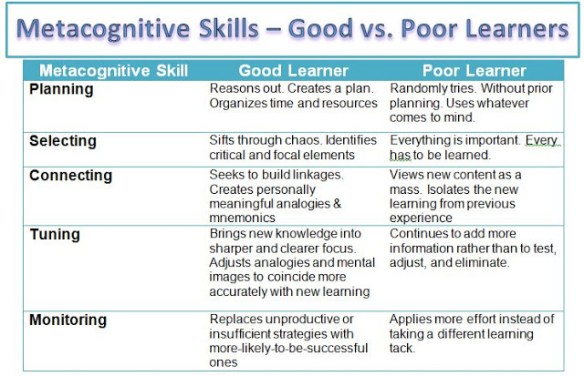
One path to get to better academic thought is through meta-cognitive strategies.
Metacognition is one’s ability to use prior knowledge to plan a strategy for approaching a learning task, take necessary steps to problem solve, reflect on and evaluate results, and modify one’s approach as needed. It helps learners choose the right cognitive tool for the task and plays a critical role in successful learning.
Fogarty (1994) suggests that metacognition is a process that spans three distinct phases, and that, to be successful thinkers, students must do the following:
Develop a plan before approaching a learning task, such as reading for comprehension or solving a math problem.
Monitor their understanding; use “fix-up” strategies when meaning breaks down.
Evaluate their thinking after completing the task.
So when we look at eliciting meta-cognition we really are trying to amplify curiosity. While giving a nod to scientific thought and inquiry as a way to try and fail, while being more accepting of our learning because we see the the failure as part of the evaluative process of learning.
As we all know stress can be really bad for your mental and physical health. Take a moment and reflect on where you fall on the chart below to measure your levels.
Also here is a Coping Checklist so you can see positive and negative ways that you Cognitively, Behaviorally, and Emotionally and Socially deal with stress.
Some kids develop anxiety and worries that interfere with learning and life. I have found that teaching breathing activities is a simple coping strategy. It helps the student get calm and centered to address the problem . Lazy 8 Breathing and Six Sided Breathing are easy visuals for even young students to use when they are feeling worried.
This video is a very good model of before and after coping strategies are taught to kids dealing with challenging issues.
There are several Curricula and Programs specific to mindfulness that include breathing strategies as a part of their curriculum. I plan on taking a course offered by Mindful Schools called Mindfulness Fundamentals to better help my practice.
Mindup (Goldie Hawn’s Foundation)
MindUP™ teaches social and emotional learning skills that link cognitive neuroscience, positive psychology and mindful awareness training utilizing a brain centric approach.
Mindful Schools- Offer training and practices to help kids and adults live more satisfying lives.
Room to Breathe Documentary
Room to Breathe, is a documentary about how mindfulness transformed the lives of 7th grade children at a San Francisco middle school with the highest district suspensions.








 Building Momentum in Schools