Kids need recess


The IPA/USA Elementary Recess Handbook presents a strong case for school recess. Here are just a few of the ways they say recess fits the bill for elementary aged children.

Recess meets a child’s social and emotional needs in these ways:

  • For many children, the chance to play with friends is an important reason for coming to school.
  • Recess can lower stress and anxiety. Without a chance to relieve stress, children sometimes resort to outbursts, nail-biting and temper tantrums.
  • Recess provides a non-threatening way for children of different cultures to learn from each other.
  • Recess gives some children a chance to break away from classmates, collect their thoughts and be alone for a while.

Recess promotes brain development and learning in these ways:

  • Students who do not get a break are much more fidgety. Plus they miss out on watching and learning from other children.
  • Unstructured play allows children to explore and exercise their sense of wonder, which leads to creativity.
  • Vigorous exercise helps the heart pump fresh oxygen into the blood to nourish sluggish brains.

Recess meets the child’s physical needs in these ways:

  • Physical activity can reduce cardiac risk factors like obesity, high blood pressure, high cholesterol and inactive life styles.
  • Play in the great outdoors stimulates the senses: children breathe fresh air, move on blades of green grass, smell fresh plants and run to favorite landmarks.
  • Through rough and tumble play, children learn about their bodies’ capabilities and how to control themselves in their environment.
  • Activities like jump rope, kickball and hopscotch encourage children to take turns, negotiate rules, and cooperate.

Source

Resources:

American Academy of Pediatrics Policy Statement: The Crucial Role of Recess in School

Scholastic Article: Recess makes kids smarter

Superduper Handout: Benefits of Recess

It’s a Kid’s Job Playing Helps Kids Learn and Grow

Here are some of the programs devoted to recess — and physical activity in general — in schools:

Playworks (playworks.org) — The company works with schools and youth organizations to create playground programs for every child, saying, “We ensure they have a place that is safe and welcoming — where they can play, thrive and contribute.” The company has programs in 21 states, including Colorado (but none listed in Pueblo so far).

Peaceful Playgrounds (peacefulplaygrounds.com) — Peaceful Playgrounds creates physical activity programs that can be purchased by organizations and schools, everything from recess kits to pedometers for students.

Yoga 4 Classrooms (yoga4classrooms.com) and Yoga Kids (yogakids.com) — These programs provide educators with training and activities to introduce simple yoga to students.

Take 10! (take10.net) — Promotes healthy movement activities.

Fuel Up to Play 60 (fueluptoplay60.com) The National Dairy Council and the NFL, with the USDA, provide programs and funds for healthy eating and physical activity programs in schools. The goal is to encourage kids to eat right and play for 60 minutes every day.

— Source: Colorado Department of Education

Kids need breakfast before school

An emerging body of research is documenting the adverse effects of skipped breakfast on various aspects of cognitive performance: alertness, attention, memory, processing of complex visual display, problem solving, and mathematics. – Basch, 2011

Research laundry list of benefits of eating and draw backs of not eating breakfast and the effects on learning.

Great Article: Does Eating Breakfast Affect Children’s Learning?

Pick the right cereal: How much sugar is in your cereal?

Hand Flapping in children

What Causes Flapping and Self-Stimulatory Behaviors?

“Self-stimulatory behaviors are common in children with autism as well as those with sensory processing disorders. However, typically-developing children sometimes do these things as well. Just because your child is flapping or doing other self-stimulatory behaviors, it doesn’t mean he has autism. Many people see a child rocking or flapping and they think, “Oh, that child has autism.” That’s not always the case!”

Source: Speech and Language Kids

Great Handout with step by step details on how to intervien with flapping behaviors: stop-flapping-handout

How to decrease hand flapping

Check in Check Out (CICO) a tool to help set expectations and improve classroom behavior

Students can be motivated to improve classroom behaviors if they have both a clear road-map of the teacher’s behavioral expectations and incentives to work toward those behavioral goals.  This modified version of Check-In/Check-Out (CI/CO) is a simple behavioral intervention package designed for use during a single 30- to 90-minute classroom period (Dart, Cook, Collins, Gresham & Chenier, 2012). The teacher checks in with the student to set behavioral goals at the start of the period, then checks out with the student at the close of the period to rate that student’s conduct and award points or other incentives earned for attaining behavioral goal(s).

First Step: Make a behavior report card for your student needing extra TLC.

Generic Behavior Report Card

Custom Behavior Report Card

Procedure. During any class session or other evaluation period when CI/CO is in effect, the teacher follows these 3 steps:

  1. Check-In. At the start of the class session, the teacher meets briefly with the student to review the behavioral goals on the Behavior Report Card and to provide encouragement. The teacher also prompts the student to set a behavioral goal on at least one of the target behaviors (e.g., “Today I will not leave my seat once without permission.”).

  2. Monitoring/Evaluation. During the session, the teacher observes the student’s behaviors. At the end of the session, the teacher rates the student’s behaviors on the Behavior Report Card.

  3. Check-Out. At the end of the class session, the teacher again meets briefly with the student. The student reports out on whether he or she was able to attain the behavioral goal(s) discussed at check-in. The teacher then shares the BRC ratings. If the student has earned a reward/incentive, the teacher awards that reward and praises the student. If the student fails to earn the reward, the teacher provides encouragement about success in a future session.

Materials: How To: Manage Problem Behaviors: Check-In/Check-Out

Role Modeling for Resilience

Kids do what we model for them. This commercial is an extreme representation of bad role modeling called “Children See. Children Do.” It does represent how our behavior as adults model behavior for our children. (VIDEO is not for the squeamish).

https://youtu.be/5JrtpCM4yMM

What is resilience?

Resilience is a dynamic process wherein individuals display positive adaptation despite experiences of significant adversity or trauma. This term does not represent a personality trait or an attribute of the individual (Luthar et al., 2000; Masten, 1999; Rutter, 1999, 2000). Rather, it is a two-dimensional construct that implies exposure to adversity and the manifestation of positive adjustment outcomes. Source

Life can be challenging and may include many stressful situations. Parents and children can feel overwhelmed by different things at different times like:

Stressful situations

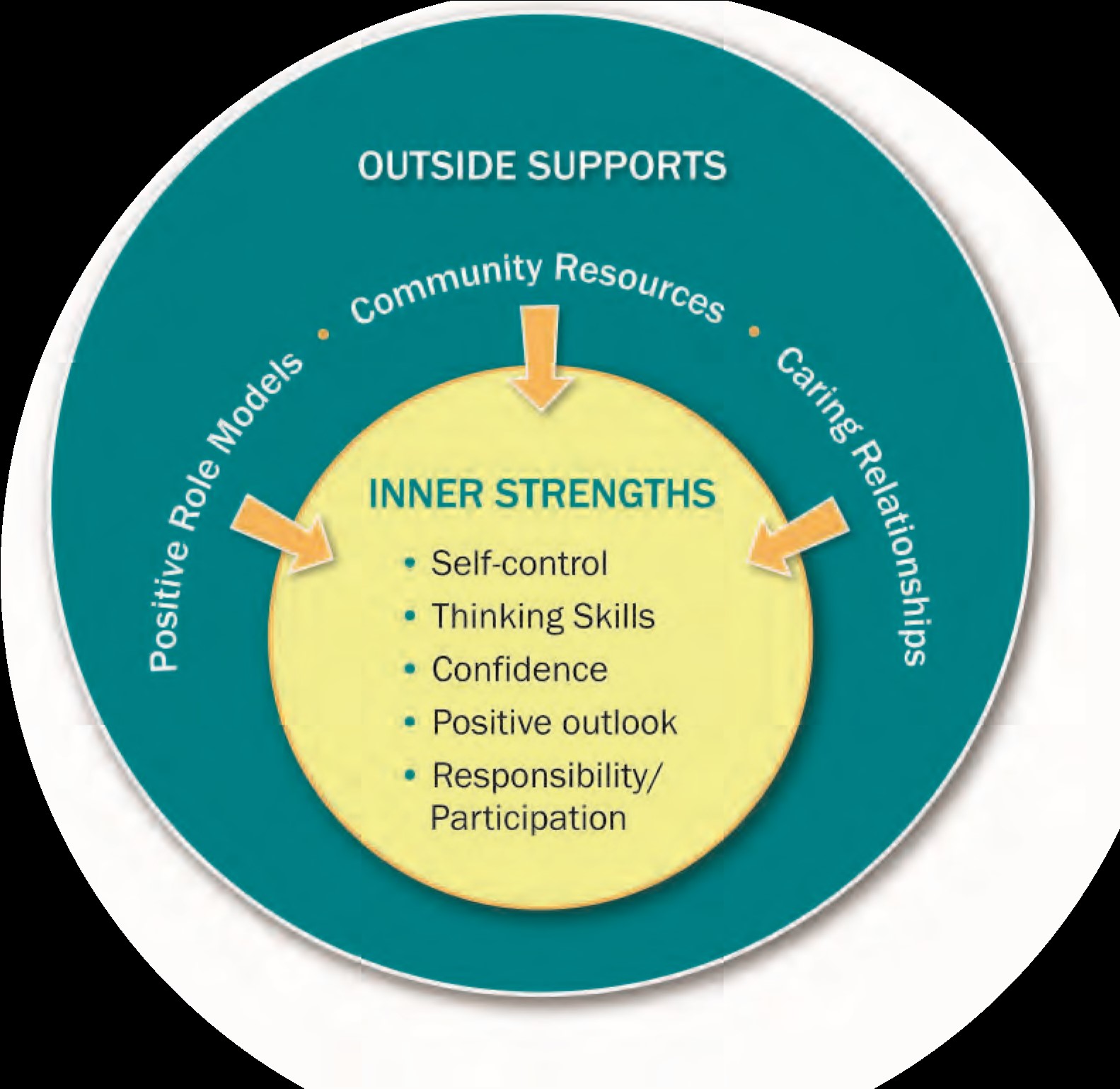
In times of need kids may need outside and inside supports:

inside and outside supports

Focus on developing multiple facets of developing a child’s sense of self in the world.

Take-The Resiliency Quiz

Cool concept: The Resiliency Doughnut

Great article on resiliency: Hard-Wired to Bounce Back- By Nan Henderson

Resources for Parents

Parenting Resilient Children at Home and at School

—www.raisingresilientkids.com

—www.dosomething.org

40 Developmental Assets for Adolescents – —www.search-institute.org

10 phrases you hear in resilient families: are you using them?

Explanatory style—thinking habits that affect our resilience

Great PowerPoint: Raising Resilient Children

Hopeful TED talk.

Talk for Educators:

Transitional and Regular Kindergarten Social Emotional Strategies and Resources

California recently adopted Transitional Kindergarten (TK).

TK is the first year of a two-year kindergarten program that uses a modified kindergarten curriculum that is age and developmentally appropriate. Pursuant to law, EC 48000(c), a child is eligible for TK if a child will have his or her fifth birthday between September 2 and December 2 (inclusive).

Behavioral adjustments are a natural phenomena with entering Kindergarten. It is especially so for our TK kiddos.

Standards really help drive our actions in schools and http://www.tkcalifornia.org/  really nails it with Seven Social-Emotional Teaching Strategies.

The dream team from the University of South Florida Rochelle Lentini and Lise Fox have developed a great simple to use Guide to making visual supports.

Here: TIPS AND IDEAS FOR MAKING VISUALS

Scripted Stories are brief descriptive stories that provide information regarding a social situation.

Scripted Stories

Student Study Teams may want to use tools to set goals and expectations for out comes from not only prescribed Standards, but also simple checklists.

Checklists:

KINDERGARTEN SOCIAL/EMOTIONAL CHECKLIST

SOCIAL SKILLS CHECKLIST

Comprehensive Kinder Readiness Checklist

Parent Cheat sheets here:

Eight Practical Tips for Parents of Young Children with Challenging Behavior

TACSEI’s “Making Life Easier” series

Family Routine Based Support Guide Early Elementary-4 to 8 years olds

NASP School Readiness

Family Routine Guide for 2-5 year olds

I was just talking to a parent about establishing routines in the evening hours with her toddler and remembered the “Family Routine Guide”. It is a wonderfully pragmatic tool to look up great interventions for common issues that come up for families with toddlers.

This Family Routine Guide was developed by Rochelle Lentini and Lise Fox to assist parents and caregivers in developing a plan to support young children who are using challenging behavior. Children engage in challenging behavior for a variety of reasons, but all children use challenging behavior to communicate messages. Challenging behavior, typically, communicates a need to escape or avoid a person/activity or communicates a desire to obtain someone/something. Once parents understand the purpose or meaning of the behavior, they can begin to select strategies to change the behavior. They can do this by selecting prevention strategies, teaching new skills, and changing the way they respond in an effort to eliminate or minimize the challenging behavior.

Family Routine Guide English

Guía de rutinas familiares (Spanish version)

Empathy

 Empathy is a 21st century skill that our kids will need more and more of in order to make the most of their future. A lot of smart organizations, schools, and businesses are cultivating this skill set in their people. It helps people not only connect, but get to the deeper detailed aspects of issues. That empathetic connection gets to better outcomes.

Brené Brown on Empathy

A father told me a story the other day about how he was driving down the road with his son in the car and was cut off by another driver. He yelled out, “Hey Buddy watch your driving!” His son then said, “Dad what if they are just learning how to drive? Take it easy.” The Dad now with this new possibility found himself calm and move on from feeling angry.

My point is that we all deal with adversity, but how we filter that information can dramatically change your reaction. This boy showed his dad that showing empathy by considering the possibility that the driver who cut his dad off could be learning how to drive and be given some leeway. Seeing possibilities is liberating, try it!

Just a last thought about how to support empathy with your special little person. Some children at school who have a hard time working through social situations often time need social skills training. Here is a great worksheet to help with breaking down a social situation to make good decisions and more importantly a teachable moment for a student.

Click to access social-problem-solving-template.pdf

Dr. Ellen Langer on Mindfullness and Mindlessness

So, as you may or may not know I am addicted to Krista Tippitt’s podcast On Being. She recently interviewed Dr. Ellen Langer on Mindfulness and Mindlessness. I was expecting something deeply connected to Buddhism with some science. This was not the case. Come to find out that for 35 or so years Dr. Langer has dedicated most of her studies toward Mindfuless and Mindlessness experiments.

The key features of what I liked about this very worthy subject is that language and perspective can largely effect us and the outcomes we seek. She proves through science that if we think in terms that reflect the positive nature of the actions we take, many of negative side effects tend to disappear. She suggests that if we allow ourselves to notice new aspects of people or topics it helps to keep our world fresh and open to possibilities, which in turn keeps our brains more in-tune and happy for lack of a better explanation.

Podcast: 

Here is a video that is equally as engaging as the podcast:

Bullying and Special Needs Students

Middle Schools can be a tough place to navigate socially for all children. For children who have cognitive and social deficits it can be especially difficult. Recently while looking into different options to help support kids on our campus, I ran across the Ohio Center For Autism and Low Incidence (OCALI) website. On the site it has a multitude of resources including some on the topic of Bullying. They have an easy to implement anti-bullying intervention called “Be an Upstander”.

Anti-Bullying Supports for Peers: Be An Upstander
Be an Upstander is a video for use with middle- and high-school students. It demonstrates strategies that can turn bystanders (persons not directly involved in the bullying incident) into Upstanders, those who can help diffuse a bullying situation. Resources to help facilitators use this video include a Facilitator Guide and Strategy List.

Webcast and Resource Materials on Bullying

Awesome Brochure

Stats from the Autism Safety Site:

A 2009 survey on bullying revealed the following:

  • 65% of parents reported that their children with Asperger’s syndrome had been victimized by peers in some way within the past year
  • 47% reported that their children had been hit by peers or siblings
  • 50% reported them to be scared by their peers
  • 9% were attacked by a gang and hurt in the private parts
  • 12% indicated their child had never been invited to a birthday party
  • 6% were almost always picked last for teams
  • 3% ate alone at lunch every day

Source: Issues in Comprehensive Pediatric Nursing (2009)