Happy kids is what we universally want to see. Check out this info-graphic on what lends to that happiness.
Happy Kids!
Image
2

Happy kids is what we universally want to see. Check out this info-graphic on what lends to that happiness.
“In the depth of winter; I finally learned that within me there lay an invincible summer”
–Albert Camus
I really like to help develop the concept with students, adults, and myself of self awareness through a process of checking in with ones self. That important swing inward to ask “Where do I stand on this topic?” is an important skill to developing a good relationship with yourself.
“Our greatness lies not so much in being able to remake the world as being able to remake ourselves.” -Gandhi
We can let the circumstances of our lives harden us so that we become increasingly resentful and afraid, or we can let them soften us and make us kinder and more open to what scares us. We always have this choice. ~ Pema Chodron
Developing Self Talk
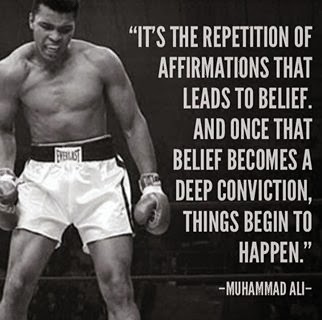
Self-talk can have a really great impact on your self-esteem and confidence. There is positive and negative self-talk and they both have an impact on how you feel. There are a few ways you can develop better self-talk including just listening to what you’re saying to yourself each day. It’s worth practicing self-talk as feeling good about yourself is worth the effort.
Self-Compassion Guided Meditations and Exercises
Dialectical Behavioral Therapy (DBT) has the concept of Wise Mind which can be a helpful tool in understanding what a inner dialog should touch upon. Finding The Balance in Opposing Forces: Dialectical Behavioral Therapy

I opened my email today and saw an article that said, “Bite your lip today”. As I read further it went on to say don’t say anything negative today. I like to think that I am positive (most days), but I like the idea of hanging on to noticing the content of what I say and do. So for today I will definitely be taking inventory of my positive out put.
Modeling this behavior is important for kids to see especially at school. I know at home with my own kids when visiting the beach or park we try to pick up some trash while we are there to keep it a little cleaner than we found it. I think the same concept should be played out with the people we interact with as much as possible.
A popular book in school is “How to fill your bucket”. Many schools have adopted this metaphor for being a good citizen. Below is a kid friendly reading of the book.
After reading the book here are some classroom ready materials to use.
Free Teachers Pay Teachers link

Adult version of the bucket filling concept. I just put it on my reading list.
A few years back I learned about Margaret Wheatley and her work around, “The Six Circle Model”. In a nut shell it is the structures of work and its interplay with the culture, communication, and relationships within that structure.
Tehama Schools Concise Synopsis


Margaret J. Wheatley (commonly Meg Wheatley) (born 1941) is an American writer and management consultant who studies organizational behavior. Her approach includes systems thinking, theories of change, chaos theory, leadership and the learning organization: particularly its capacity to self-organize. Her work is often compared to that of Donella Meadows and Dee Hock. She describes her work as opposing “highly controlled mechanistic systems” that only create robotic behaviors.
In any organization you must find a blend of melding above and below the green line. I think that in my work when we have been faced with a problem, considering what might be missing on the “The Six Circle Model” has really helped our teams better reset on a path to better practices.
At this time in our history, we are in great need of processes that can help us weave ourselves back together. We’ve lost confidence in our great human capabilities, partly because mechanistic organizational processes have separated and divided us, and made us fearful and distrusting of one another. We need processes to help us reweave connections, to discover shared interests, to listen to one another’s stories and dreams. We need processes that take advantage of our natural ability to network, to communicate when something is meaningful to us. We need processes that invite us to participate, that honor our creativity and commitment to the organization. – Margaret Wheatley
Kids do what we model for them. This commercial is an extreme representation of bad role modeling called “Children See. Children Do.” It does represent how our behavior as adults model behavior for our children. (VIDEO is not for the squeamish).
What is resilience?
Resilience is a dynamic process wherein individuals display positive adaptation despite experiences of significant adversity or trauma. This term does not represent a personality trait or an attribute of the individual (Luthar et al., 2000; Masten, 1999; Rutter, 1999, 2000). Rather, it is a two-dimensional construct that implies exposure to adversity and the manifestation of positive adjustment outcomes. Source
Life can be challenging and may include many stressful situations. Parents and children can feel overwhelmed by different things at different times like:

In times of need kids may need outside and inside supports:
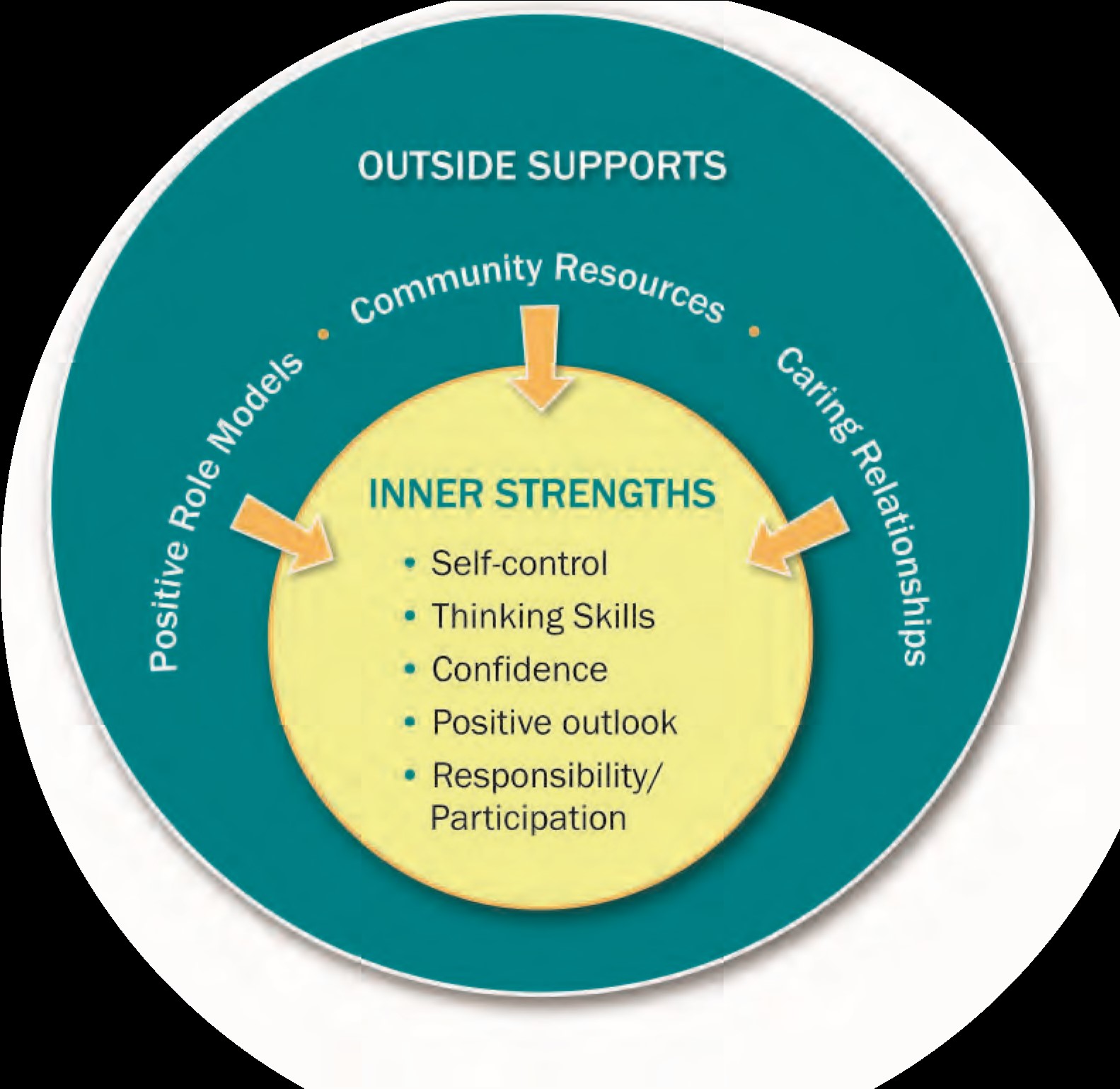
Focus on developing multiple facets of developing a child’s sense of self in the world.

Take-The Resiliency Quiz
Cool concept: The Resiliency Doughnut
Great article on resiliency: Hard-Wired to Bounce Back- By Nan Henderson
Resources for Parents
Parenting Resilient Children at Home and at School
40 Developmental Assets for Adolescents – www.search-institute.org
10 phrases you hear in resilient families: are you using them?
Explanatory style—thinking habits that affect our resilience
Great PowerPoint: Raising Resilient Children
Hopeful TED talk.
Talk for Educators:
I have to share that when I walk my kids in the stroller on the weekend, I habitually listen to Krista Tippet interviewer extraordinaire. She picks topics that keep my head swimming in possibilities. This week she interviewed Rex Jung on Creativity. I think that this is really relevant for educators and especially School Psychologist who are constantly having to measure children’s potential in a variety of areas.
*One thing I did not like during the interview was the use of the word “Retarded”. I think that they should have been savvy enough to use the more modern, respectful, accurate descriptor of “Intellectual Disability”. UPDATE: I emailed Rex Jung about this terminology and he promptly responded, saying he wishes that we could do away with all labels. I agree with him and think he has his heart in the right place when it comes to people in general.

is an Assistant Professor of Neurosurgery at the University of New Mexico in Albuquerque. He’s a Distinguished Senior Advisor to the Positive Neuroscience Project, based at the University of Pennsylvania.

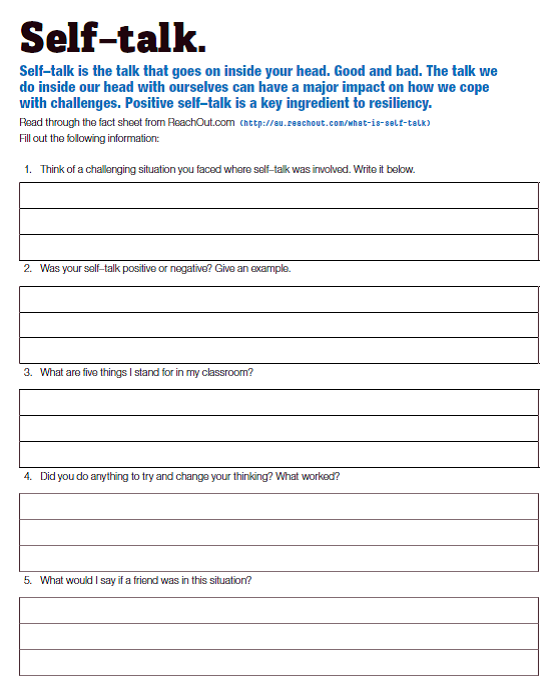
Negative self talk can plague a student’s success in the classroom.
Worksheet: here

Five Key Points
In What Students Say to Themselves: Internal Dialogue and School Success (Thousand Oaks, CA: Corwin Press, 2000), William Watson Purkey suggests the following five points to keep in mind as you try to shape students’ self-talk:
|
Teacher Notes here
One path to get to better academic thought is through meta-cognitive strategies.
Metacognition is one’s ability to use prior knowledge to plan a strategy for approaching a learning task, take necessary steps to problem solve, reflect on and evaluate results, and modify one’s approach as needed. It helps learners choose the right cognitive tool for the task and plays a critical role in successful learning.
Fogarty (1994) suggests that metacognition is a process that spans three distinct phases, and that, to be successful thinkers, students must do the following:
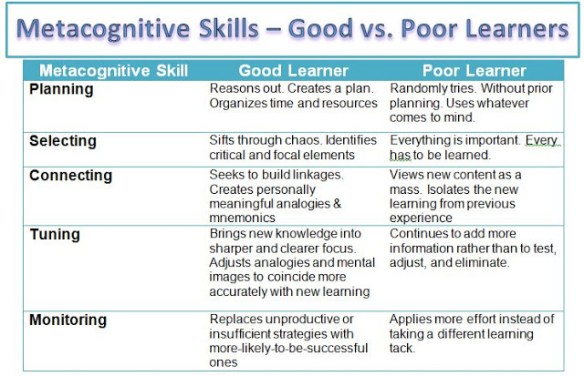
So when we look at eliciting meta-cognition we really are trying to amplify curiosity. While giving a nod to scientific thought and inquiry as a way to try and fail, while being more accepting of our learning because we see the the failure as part of the evaluative process of learning.


As we all know stress can be really bad for your mental and physical health. Take a moment and reflect on where you fall on the chart below to measure your levels.
The Holmes and Rahe Stress Scale

Be good to yourself and practice good self care.
Here is an inventory to check to see how you are doing with your self care.
Also here is a Coping Checklist so you can see positive and negative ways that you Cognitively, Behaviorally, and Emotionally and Socially deal with stress.
Go further and log your progress for a week (See Below).

Empathy is a 21st century skill that our kids will need more and more of in order to make the most of their future. A lot of smart organizations, schools, and businesses are cultivating this skill set in their people. It helps people not only connect, but get to the deeper detailed aspects of issues. That empathetic connection gets to better outcomes.
Brené Brown on Empathy
A father told me a story the other day about how he was driving down the road with his son in the car and was cut off by another driver. He yelled out, “Hey Buddy watch your driving!” His son then said, “Dad what if they are just learning how to drive? Take it easy.” The Dad now with this new possibility found himself calm and move on from feeling angry.
My point is that we all deal with adversity, but how we filter that information can dramatically change your reaction. This boy showed his dad that showing empathy by considering the possibility that the driver who cut his dad off could be learning how to drive and be given some leeway. Seeing possibilities is liberating, try it!

Just a last thought about how to support empathy with your special little person. Some children at school who have a hard time working through social situations often time need social skills training. Here is a great worksheet to help with breaking down a social situation to make good decisions and more importantly a teachable moment for a student.
So, as you may or may not know I am addicted to Krista Tippitt’s podcast On Being. She recently interviewed Dr. Ellen Langer on Mindfulness and Mindlessness. I was expecting something deeply connected to Buddhism with some science. This was not the case. Come to find out that for 35 or so years Dr. Langer has dedicated most of her studies toward Mindfuless and Mindlessness experiments.
The key features of what I liked about this very worthy subject is that language and perspective can largely effect us and the outcomes we seek. She proves through science that if we think in terms that reflect the positive nature of the actions we take, many of negative side effects tend to disappear. She suggests that if we allow ourselves to notice new aspects of people or topics it helps to keep our world fresh and open to possibilities, which in turn keeps our brains more in-tune and happy for lack of a better explanation.
Podcast:
Here is a video that is equally as engaging as the podcast:
 Building Momentum in Schools